Wet Drywall by Hour Six. The Local Rules That Decide How Much of It Gets Cut
Two crews can look at the same soaked wall and give opposite answers, and the difference is often licensing, climate and the local floodplain ordinance rather than skill.
Enzo Battaglia4 min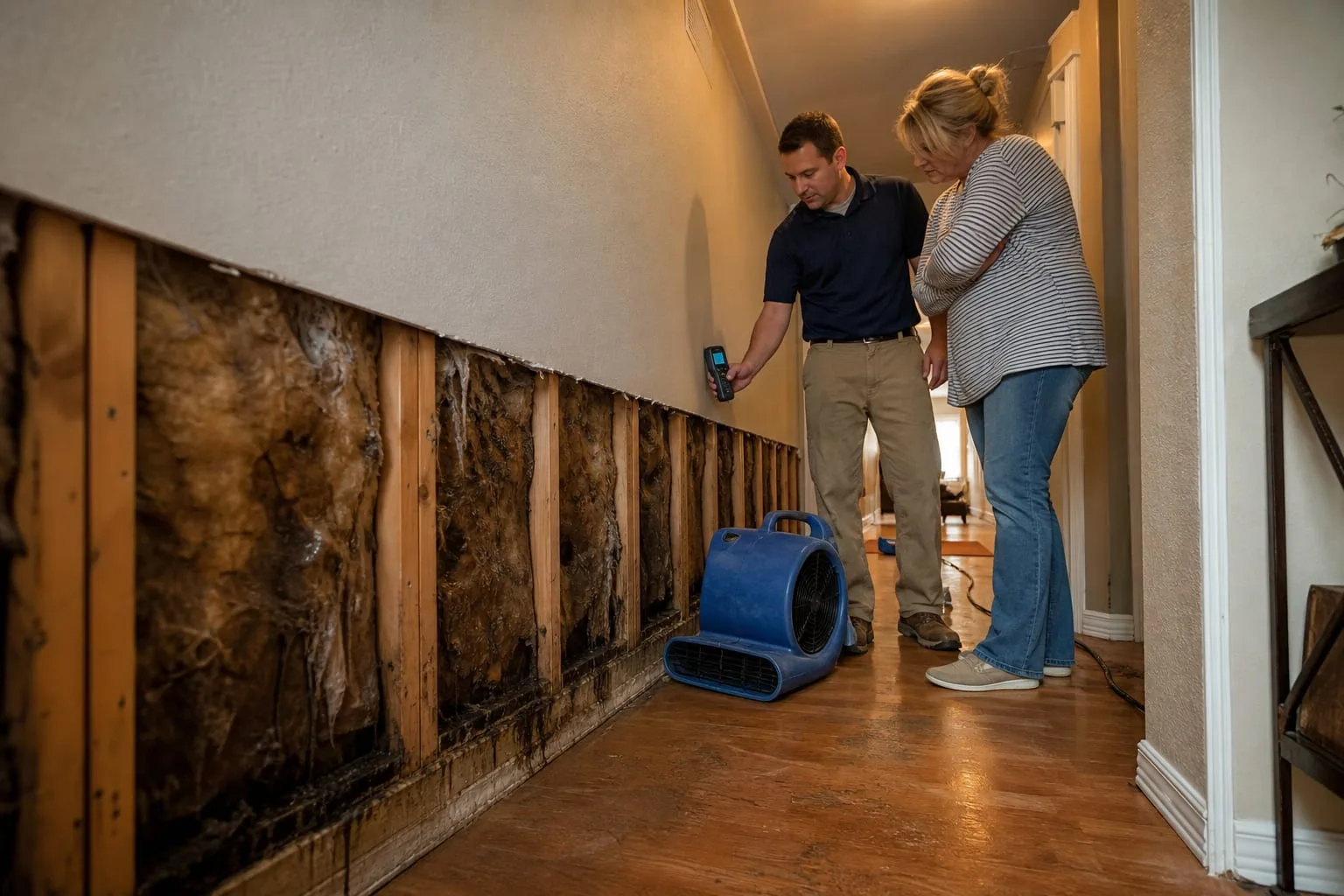
The pressure in the first two days is not really about drying equipment. It is about a sequence of judgment calls made quickly, by people standing in your hallway, about how much material comes out and how much stays. A crew arrives, walks the room with a moisture meter, and tells you the bottom two feet of drywall have to go, plus the baseboard, plus the pad under the carpet. Maybe that is right. Maybe half of it is. The way to decide is not to become an expert in drying science overnight, but to understand what actually drives the recommendation, and how much of it is local rather than universal.
What the first call is really deciding
Three variables set almost everything that follows. The first is the source: clean supply water, gray water from an appliance or a shower drain, or sewage, and each category moves the answer further toward removal rather than drying. The second is time, because the same clean water that could have been dried in place at hour four behaves differently at hour thirty. The third is what the water is sitting in, since a wall cavity with fiberglass batt and a vapor barrier holds moisture in a way an open joist bay does not. When you understand those three, you can ask a crew to explain their recommendation in those terms, and a competent one will.
What you are listening for is whether the answer is specific to your house. A technician who says the pad is unsalvageable because the water came off a toilet supply line downstream of a wax ring failure is reasoning. A technician who says everything below the flood line always comes out, in every job, on every street, is reciting. Neither is necessarily wrong, but only one of them can be tested against the readings, and the readings are the thing you should be shown rather than told about.
The same wet wall, three different answers
Regional rules change the shape of the job more than most homeowners expect. Several states, Florida, Texas, New York and Louisiana among them, license mold assessment and mold remediation separately, and in those states the company that tells you what is contaminated is generally barred from being the company paid to remove it. That structural separation exists precisely because the incentive runs one way. In states without it, the same firm writes the scope and bills the scope, which is not scandal, it is simply a reason to look twice at the line items.
Climate pushes the same way. On the Gulf Coast, ambient humidity means a wall that is merely damp can stay wet long enough to matter, so crews cut earlier and dry harder. In the arid Southwest, the same wall may release moisture on its own in a way that makes aggressive demolition genuinely unnecessary. In cold climates, the driving question in January is whether the water came from a freeze event that will repeat the moment the heat cycles, which turns a drying job into a plumbing and insulation job. Ask which of these your crew is reasoning from.
The local rules that outrank the contractor's opinion
Two local rules can override everything a crew tells you, and both are worth checking before demolition starts. If the house sits in a mapped flood zone, the community's floodplain ordinance likely contains a substantial damage provision, under which repair costs exceeding a set share of the structure's value trigger a requirement to bring the whole building into compliance, which can mean elevation. That determination is made by the local floodplain administrator, usually in the building department, not by your contractor, and finding out after the walls are open is an expensive order of operations.
The second is age. In housing built before 1978, disturbing painted surfaces brings the federal lead renovation rules into play, and the Environmental Protection Agency oversees both those requirements and the federal guidance on mold in buildings. Older homes also raise asbestos questions in floor tile, mastic and joint compound, and several states and counties require testing before demolition regardless of square footage. A crew that already knows your jurisdiction's threshold is telling you something useful about how often they work there.
When the second look earns its fee
An independent inspection is worth paying for when the scope and the money have separated from each other: when the proposed demolition is large, when the insurer's adjuster and the contractor disagree, when the water was gray or worse, or when anyone in the household has asthma or is immunocompromised. Hire someone who does not stand to be paid for the repairs, which in licensed states means an assessor and elsewhere means an indoor environmental professional or a licensed engineer.
Tell them what to look for rather than asking for a general opinion. Moisture mapping of every affected assembly with readings recorded by location, cavity readings taken behind the drywall rather than at the surface, an outdoor and unaffected-room baseline for comparison, confirmation of the water category and its source, a check of whether containment and negative pressure were set up correctly, and a written statement of which materials can be dried in place and which cannot. That document is what makes the next conversation short.
The homeowners who come out of this well are rarely the ones who knew the most. They are the ones who asked for readings, checked two rules before the saw came out, and paid a few hundred dollars to have someone with no stake in the answer confirm it.