Three Air Movers or Eleven? The Invoice Reviewer Who Decides What Drying Costs
Water mitigation is billed by equipment, days and documented readings, and the person who approves that bill is usually someone the homeowner never speaks to.
Nikolai Dragomir4 min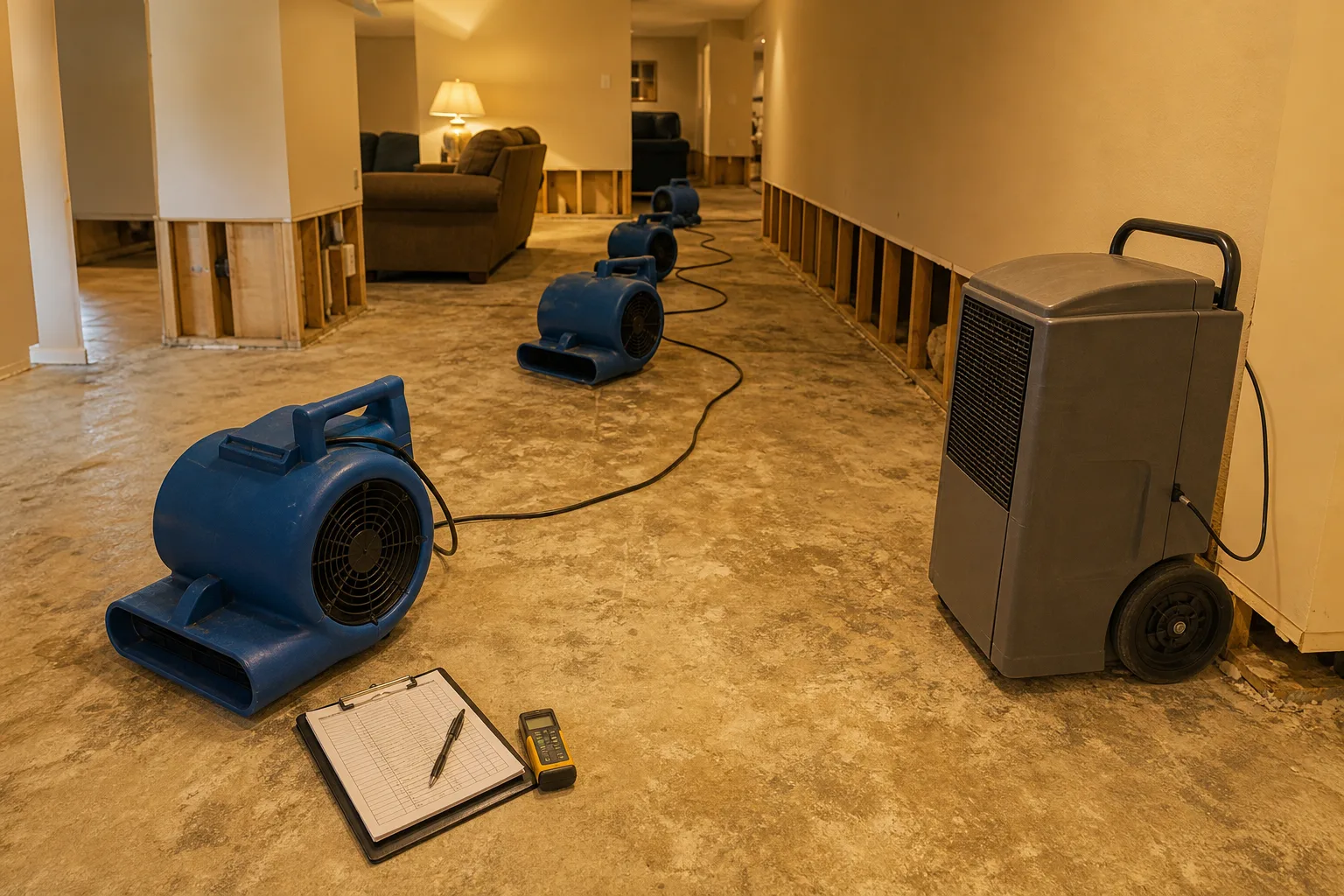
The supply line lets go at eleven at night, and by the time the water is shut off you are standing on carpet that squelches, with a phone in your hand and three numbers you could call. The order matters less than most people think, with one exception: the water has to stop first, which means the fixture stop or the main, and then the power to any circuit that is wet. After that, the clock that governs cost starts running, and almost every dollar on the mitigation invoice you will eventually receive is a function of how many hours passed before air started moving and how well anyone wrote down what they found.
What the first hour decides, and what can genuinely wait
Water stopped, power isolated, standing water pushed out with a wet vacuum or a mop if you have one: those three things are worth doing at midnight, because the material that stays saturated longest is the material that comes out instead of drying in place. Photograph the room before you move anything, including the source, the water line on the baseboard, and the contents sitting in it. What can wait until morning is the adjuster, the flooring estimate, the question of whether the hardwood is salvageable, and any conversation about who pays. None of those improve by being had at one in the morning, and all of them go better once you have readings to talk about.
What should not wait is the mitigation call, because the firms that do this work dispatch overnight and because the first drying day is the cheapest day you will buy. The Environmental Protection Agency is the federal body responsible for guidance on indoor moisture and mold, and the practical point running through all of it is that wet materials become a biological problem within the first day or two rather than the first week. A crew arriving at two in the morning with ten air movers is not upselling you. They are buying back the days that cost the most.
What the invoice is actually made of
Mitigation is not priced like a renovation. It is priced as a rental: each air mover carries a per-unit, per-day charge, each dehumidifier carries a larger one, and the total is those unit-days multiplied out, plus labor for the initial setup and extraction, plus a monitoring visit on each day the equipment stays. Add containment if the work area has to be sealed, antimicrobial application if the water was not clean, and specialty gear if the water went somewhere ordinary airflow cannot reach, which is the usual story with hardwood floors, wall cavities and the underside of a subfloor. The shape of the bill, then, is equipment count times days, and those two numbers trade against each other.
This is where drying properly and drying quickly stop being the same decision. More equipment dries faster and costs more per day, but it may cut four days to two, which can produce a smaller total. Less equipment running longer looks restrained on day one and produces a larger total by day six, plus six monitoring visits instead of three, plus a meaningfully higher chance that something sitting at the edge of wet never crosses back and has to be cut out. The expensive outcome is not fast drying or slow drying. It is slow drying that fails, after which you pay for the mitigation and the demolition and the rebuild.
The party nobody in the room represents
Homeowners picture this transaction as a triangle: themselves, the restoration firm, and the adjuster who comes out to look. There is a fourth party, and in practice it has more influence over the final number than the adjuster who stood in your hallway. Most carriers route water mitigation invoices to a third-party review vendor, a desk operation that audits the line items against published industry drying standards and against the carrier's own thresholds for equipment per room, per cubic foot and per day. That reviewer never sees the house. It sees an invoice, a moisture log, a sketch and a set of photographs, and it decides which of those unit-days were justified.
The consequences are specific. Equipment billed for a day on which no moisture reading was recorded is the first thing cut. Eleven air movers in a room the sketch shows as small gets reduced to the formula count. A dehumidifier left running after the readings show the material is dry gets trimmed back to the day it should have come out. None of this is hostile, and the reviewer is applying a standard rather than an opinion, but it means the invoice you are responsible for is scored against documentation you never saw being created. The restoration firms that handle this well treat the log as part of the job, and it is entirely reasonable to ask, on day one, who is recording the readings and whether you will get copies.
Drying in place versus taking it out
The other cost fork is whether material gets dried or removed, and it is decided by category of water, by how long it sat, and by what the material is. Clean supply water caught within hours lets a crew dry carpet in place, dry the pad, and float the carpet back. Water that sat three days, or water that came from a drain line, usually moves pad and base trim into the dumpster regardless of how good the equipment is. Drywall is cheap to replace and slow to dry, so cutting a flood line is often the lower total. Hardwood is the reverse: specialty mat systems are expensive per day and still cheaper than a floor.
Ask the crew chief which category they have called it and why, because that single classification drives tear-out, antimicrobial treatment, containment and the reviewer's expectations all at once. Get it in writing on the first work authorization you sign.
Keep your own copy of every daily reading sheet, and keep the photographs you took before anything moved. When the invoice reaches the desk that scores it, those pages are the argument, and a homeowner who has them rarely has to make it twice.