The Debris You Set Out Tuesday and the Call You Recorded. Your State Decides Which One Counts
Most disputes are lost in the first hour, when the failed part leaves in a truck and the recorded call turns out to be worthless in your state.
Nikolai Dragomir4 min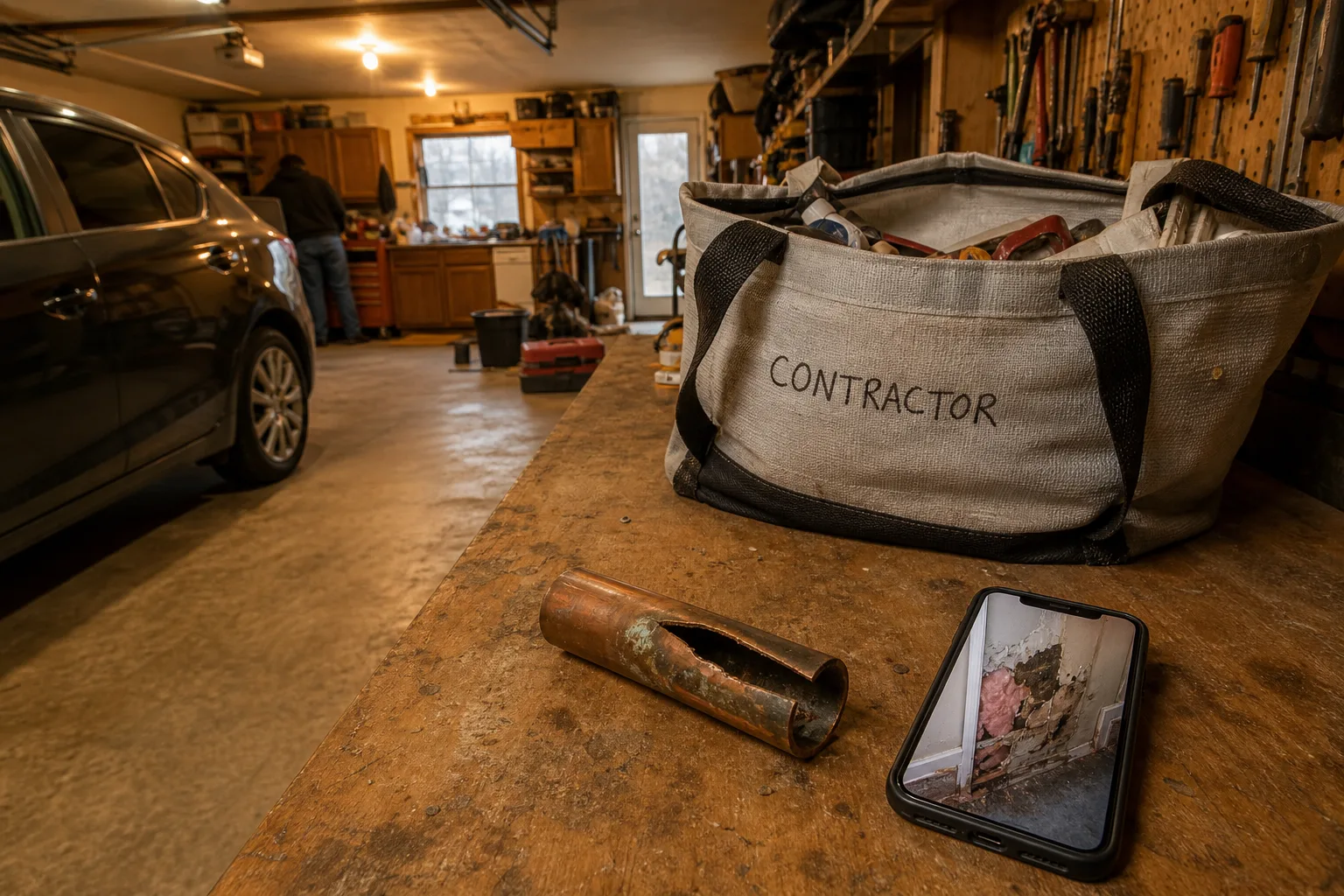
The failed part leaves the house in the plumber's truck. The soaked baseboard goes to the curb because bulk pickup comes Tuesday and the smell is getting bad. Nine weeks later an adjuster, an attorney, or a state licensing board asks a question that only the baseboard could have answered, and the honest reply is that it went out with the yard waste. Almost nobody traces a lost dispute back to that moment, because the moment did not feel like a decision. It felt like cleaning up. The first hour after something goes wrong is when the evidence either survives or quietly does not.
What leaves the property in the first hour is usually gone for good
Whoever shows up to fix the problem has a professional habit of taking the broken thing with them: the burst supply line, the cracked heat exchanger, the scorched outlet, the section of pipe with the pinhole. That is normal and not sinister, but it removes the only object that can settle a question about cause, age, or installation. Ask for it, in those words, before work starts, and put it in a bag or a box in the garage. Photograph the failure in place first, from far enough back that the room is identifiable, then close enough to read a model plate. Serial numbers matter more than drama.
The same applies to anything a contractor or insurer may later want to inspect. Courts and insurers both take a dim view of destroyed evidence, and in a dispute the party who threw the thing out tends to absorb the doubt. That cuts in your favor when you keep it. The practical version is unglamorous: a contractor bag in the garage, labeled with a date, holding wet drywall cores, the failed valve, the shingle that came off. It can be discarded once the claim closes. It cannot be recovered once the truck pulls away.
Recording the call is not the same decision in every state
People record contractors and claims representatives constantly now, because the phone makes it a single tap, and they assume the recording is the trump card. Whether it is depends entirely on where the parties were sitting. Some states require only that one participant consents, which means you may record your own conversation without telling anyone. Others require that everyone on the line consents, and in those states a secret recording is not merely inadmissible but can expose the person who made it to liability. Calls that cross state lines complicate the question further, and the safer practice is to assume the stricter rule applies.
There is a version that works everywhere and takes less effort. Hang up and send an email summarizing what was said, naming the person, the date, and the commitment: you told me the slab would cure before the frame went up, you told me the deductible applies once. If the account is wrong, the other side corrects it in writing, which is also useful. If nobody corrects it, you have a contemporaneous record that no consent statute touches. Same evidentiary weight in most practical disputes, none of the legal exposure.
The letter your state requires before you are allowed to complain
A large share of construction and home improvement complaints are dismissed or stalled not on the merits but on a procedural step the homeowner never heard of. Many states have notice-and-opportunity-to-repair statutes, which require a homeowner to send the contractor written notice describing the defect and then wait a set number of days before filing suit. The required content, the delivery method, and the waiting period all vary by state, and some require certified mail with return receipt rather than an email thread. Skipping it rarely ends the claim permanently, but it resets the clock at the worst possible time.
Licensing boards layer their own rules on top. A state contractor board may accept complaints only within a certain window after the work, may require that you have already attempted resolution directly, or may run a recovery fund with its own separate and shorter deadline. Small claims limits differ by state as well, which determines whether a dispute of a given size goes to a simple hearing or a real civil filing. The Federal Trade Commission oversees consumer protection at the federal level and takes complaints, though the deadlines that actually bind you are usually state ones. Find yours in week one, not month three.
What genuinely can wait until morning
Not everything that feels urgent is. Getting three competing repair estimates can wait; so can the argument about who pays, the review you want to post, and the decision about whether to hire an attorney. What cannot wait is preservation: photographs before anything is moved, the failed component set aside, moisture readings taken while the material is still wet, and a note of who was present and when. Write the timeline that night while it is accurate to the hour. A homeowner who does those four things in the first hour arrives at every later conversation holding the version of events that other people have to work around.
Evidence rarely fails because it was weak. It fails because it was discarded, recorded in a state that did not allow it, or submitted after a deadline nobody mentioned. All three are fixable before they happen, and the fix costs an hour and a box in the garage.