Dust a Week After Cleaning, a Cold Back Bedroom. The Season Behind Both
The everyday annoyances people blame on an old house usually trace back to a two-hour job that slipped a season, and the calendar for those jobs has moved.
Greta Holmqvist4 min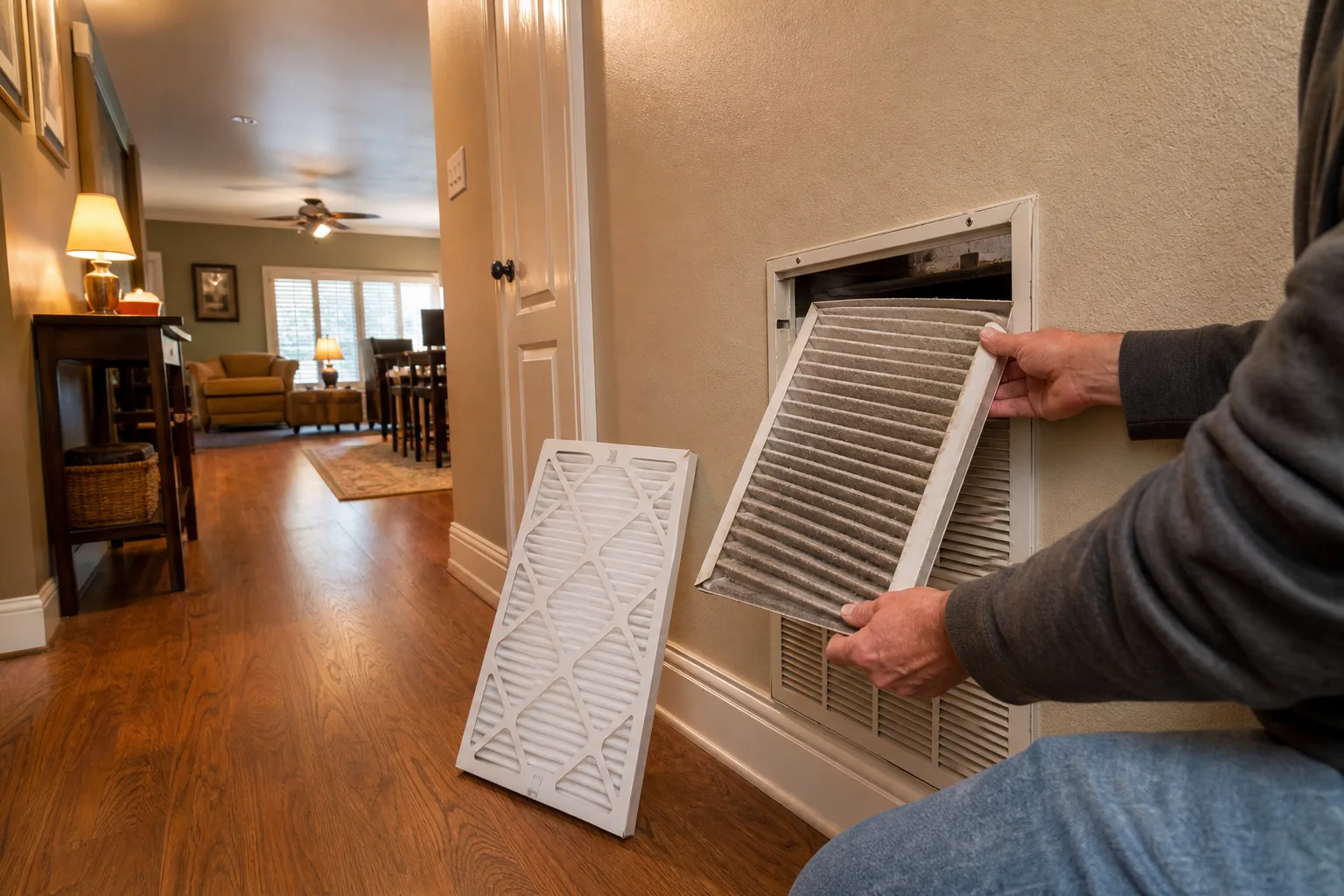
The complaint usually arrives as something else. Dust settles on the windowsill four days after you wiped it, the back bedroom runs five degrees cold no matter where the thermostat sits, the dishwasher leaves grit on the top rack, a storm door that closed cleanly in June now needs a shoulder. None of these announce themselves as maintenance. They present as an aging house, a bad appliance, a room that was always like that. In most cases they are the visible end of a two-hour job that slipped past its window, and the window itself has moved in the last few years.
The symptoms nobody files under upkeep
Resettling dust is the clearest example. When a forced-air filter has gone past its service life, the media loads up, air finds the gaps around the frame instead of going through, and the system circulates what it is supposed to capture. You notice it as housekeeping failure. The cold back bedroom is often the same system telling you something different: a restricted return, a damper that was closed for summer and never reopened, a blower working against resistance it should not have. The grit on the dishwasher rack is a filter at the base of the tub that has not been pulled and rinsed since the machine was installed. Each of those is twenty minutes of work with a consequence measured in months of mild irritation.
The pattern holds outside the house too. A gutter that overflows at the corner stains the siding, soaks the bed beneath it, and eventually finds the sill plate, but what the homeowner reports is that the hydrangeas keep dying. Weatherstripping that has flattened does not read as weatherstripping. It reads as a drafty room, a higher gas bill, and a door that sticks because the frame has moved slightly with moisture it is no longer kept out of. The cost is almost never in the repair. It is in the things the deferral quietly pushes onto other line items.
What actually changed about the calendar
Two things have shifted, and both matter for when you book. The first is leaf drop. In much of the country the final drop now runs later than the schedule most people inherited, which means the gutter cleaning booked for the second week of October clears about two thirds of what is coming and leaves the rest to pack down over winter. Crews know this and many have split the service into an early pass and a late pass, or moved the single pass toward Thanksgiving. If you are still calling on the old date, you are paying full price for a partial job and finding out in February.
The second is that heating season and cooling season have stopped being separate for a growing number of houses. A heat pump runs the same outdoor unit year round, so the old rhythm of a spring air conditioning tune-up and a fall furnace check does not map onto it. The outdoor coil needs clearing before each heavy season rather than once, and the defrost cycle gives you a winter failure mode that a furnace never had. There is also a refrigerant transition underway in new equipment, overseen by the Environmental Protection Agency, which is one reason service companies have been rebuilding their maintenance plans and reaching out to customers they had not contacted in years.
Why the two-hour job is the hardest one to book
A contractor's day is built around drive time, and a job that bills two hours of labor can easily consume four hours of a van's day once travel, parking, and the supply house are counted. That is why so many shops now publish a minimum charge, often covering the first hour or two whether the work takes that long or not, and why the small job sits in the schedule behind larger ones. It is not reluctance. It is arithmetic. The practical answer is to stop treating each item as its own phone call and start keeping a running list on the refrigerator, so that when you do call, you are buying a half day rather than begging for twenty minutes.
Bundling works best within a trade. The HVAC visit that replaces the filter can also check the condensate line, clear the outdoor coil, and look at the dryer vent termination while the tech is already outside with a ladder. The plumber coming for a dripping hose bib can flush the water heater and swap the washing machine supply hoses in the same trip, and the handyman hour you were going to spend on the storm door closer will stretch across three doors of weatherstripping if the materials are already sitting on the bench.
A schedule that survives contact with a real year
The schedules people keep are the ones anchored to something they already do, not to dates on a printed chart. Filters get changed when the clocks change. Gutters get booked when the last tree on the street is bare, not on a fixed week. The water heater gets flushed the weekend the holiday guests leave. Smart thermostats and appliance apps now push runtime and filter reminders directly, which removes the one step that always failed, which was remembering. Tie the list to events, keep it on paper where everyone can see it, and the two-hour jobs stop turning into the symptoms you cannot place.
The honest test of any maintenance plan is whether you can name the last time each item was done. If three or four answers come back as a shrug, that is the call to make, and it is one visit, not four.