A Two-Hour Faucet Swap, Priced Two Ways. Where the Hourly Rate Stops Being Cheaper
One small plumbing job, quoted hourly by one shop and flat rate by another, explains why short repairs are hard to book and what each pricing model is actually charging you for.
Greta Holmqvist5 min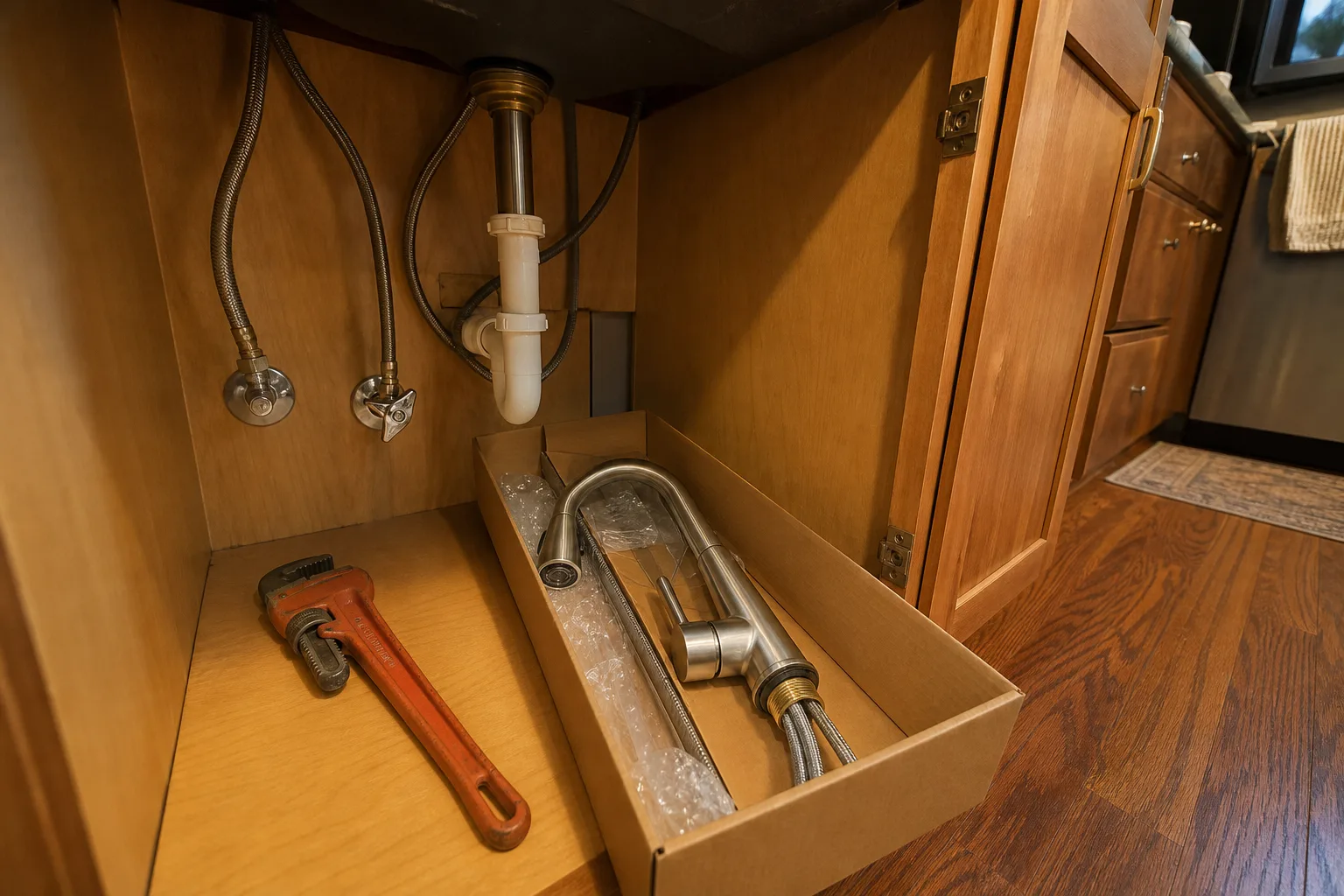
The kitchen faucet has been dripping at the base for a month, the finish is pitting, and the replacement is already sitting in its box on the counter. Two plumbing companies return the call. One quotes $145 an hour with a one-hour minimum and says the job usually runs ninety minutes to two hours. The other quotes $385, flat, parts of their own not included, and will not break the number down. The second quote is higher than two hours at the first shop's rate, which makes it look like the obvious loser. It frequently is not, and the reason has very little to do with either company's honesty.
What the hourly number leaves outside the frame
An hourly rate prices the time a technician spends inside your house with tools in hand. It does not usually price the drive, the parking, the twenty minutes at the supply house for an angle stop that turned out to be the wrong thread, or the dispatcher who moved two other calls to fit you in. Those costs still exist, so they get recovered somewhere: a trip charge, a one or two hour minimum, a shop supply fee calculated as a percentage, or a rate set high enough that short jobs subsidize themselves. When you compare $145 an hour against $385 flat, you are not comparing two prices for the same thing. You are comparing two different definitions of what you are buying.
The practical consequence shows up before any money changes hands, at the scheduling stage. A company billing by the hour earns on a two-hour faucet swap only if the truck is already in your zip code and the next call is close by. So the small job gets offered Thursday afternoon, or next Tuesday, or the week after, always in the window nobody else wanted. Homeowners read that as being deprioritized, and in a narrow sense they are, but the cause is arithmetic rather than attitude. A one-hour minimum on a job with forty minutes of driving in each direction loses the company money, and the dispatcher knows it before you do.
Who absorbs the shutoff valve that crumbles
Here is where the faucet job stops being generic. Under the sink are two angle stops, probably original, probably multi-turn chrome with a packing nut that has not moved since the house was built. Maybe a quarter of the time on an older house, one of them weeps when it is closed, or the handle turns without stopping the water, or the compression nut shears. That is another thirty to sixty minutes, sometimes a trip to shut the main and drain the line, occasionally a call the next morning because the stop is soldered to a copper stub that has to be cut.
On the hourly ticket, you pay for all of it, and you find out what it cost when the invoice is written. On the flat rate ticket, the answer depends entirely on how the book price was written. Some flat rate books price the faucet install with the assumption that stops are serviceable and the stops are a separate line item, which means a change order and a conversation at the sink. Others build the likely failure into the number, which is one of the honest reasons a flat price can look inflated on the easy jobs. Ask which it is. That single question tells you more about the final bill than the rate comparison does.
The asymmetry matters because the risk is not evenly distributed. Hourly pricing hands the uncertainty to you and gives the technician no financial reason to hurry, which cuts both ways: careful work is not penalized, but neither is a slow Monday. Flat rate pricing hands the uncertainty to the company and gives the technician a reason to move, which rewards efficiency and occasionally rewards shortcuts. Neither structure makes anybody dishonest. It just determines who is watching the clock, and a homeowner who knows which one applies will interpret the day very differently.
The upsell is a feature of the model, not a character flaw
Flat rate shops typically send technicians out with a tablet and a price book covering several hundred tasks, and the technician's job includes presenting options: the faucet, yes, but also the two angle stops, the braided supply lines, the garbage disposal that hums, the water heater's expansion tank. People find this uncomfortable and read it as pressure. What is actually happening is that the company's unit of sale is the task, not the hour, so adding tasks is the only way the visit grows. The second faucet-adjacent task is usually priced well, because the drive and the setup are already paid for. The third one often is too.
Which points at the decision most households get wrong. If you have three small plumbing problems, a slow lavatory drain, a running toilet flapper, and the faucet, do not solve them one at a time across four months. Solve them in one visit. Under hourly billing, you pay one trip charge and clear the minimum with work you actually wanted done. Under flat rate, you often qualify for a lower second and third task price and you avoid paying the embedded travel cost three times over. The bundled visit is the single most reliable way a homeowner lowers the cost of small work, and it costs nothing but a list kept on the refrigerator.
Getting a comparable number out of two different systems
You can force the two quotes onto the same footing with four questions, asked on the phone before anyone is dispatched. What is the total if the job goes exactly as expected. What is the total if both angle stops have to be replaced. Is the diagnostic or trip fee credited against the work if I approve it. And is the quote firm once the technician has looked under the sink, or is it an estimate that can move. Write the four answers down for both companies. The $385 flat quote and the $145 hourly quote usually land within sixty or eighty dollars of each other once the bad-stop scenario is priced, and sometimes the flat number comes in lower.
Get whichever version you choose in writing before work starts, including the condition that triggers a change order. The Federal Trade Commission is responsible for how prices and estimates are represented to consumers, and a written estimate that names the scope, the parts, and the circumstances under which the number changes is the document that settles any later disagreement in about a minute. Photograph the under-sink area first. It takes ten seconds and establishes what the valves looked like before anyone touched them.
The faucet will get replaced either way, and on most Thursdays the difference between the two invoices is smaller than the hour you spent worrying about it. The real gain from understanding the two models is upstream: you stop treating a two-hour repair as a thing to be squeezed in alone, and you start saving them up until a visit is worth making.