The Cleaner Sees It First. Why Nobody Ever Asks What They Found
A maintenance contractor on what small neglect actually costs, what drives the number, and why the person already in your house every week is the cheapest inspection you never asked for.
Enzo Battaglia4 min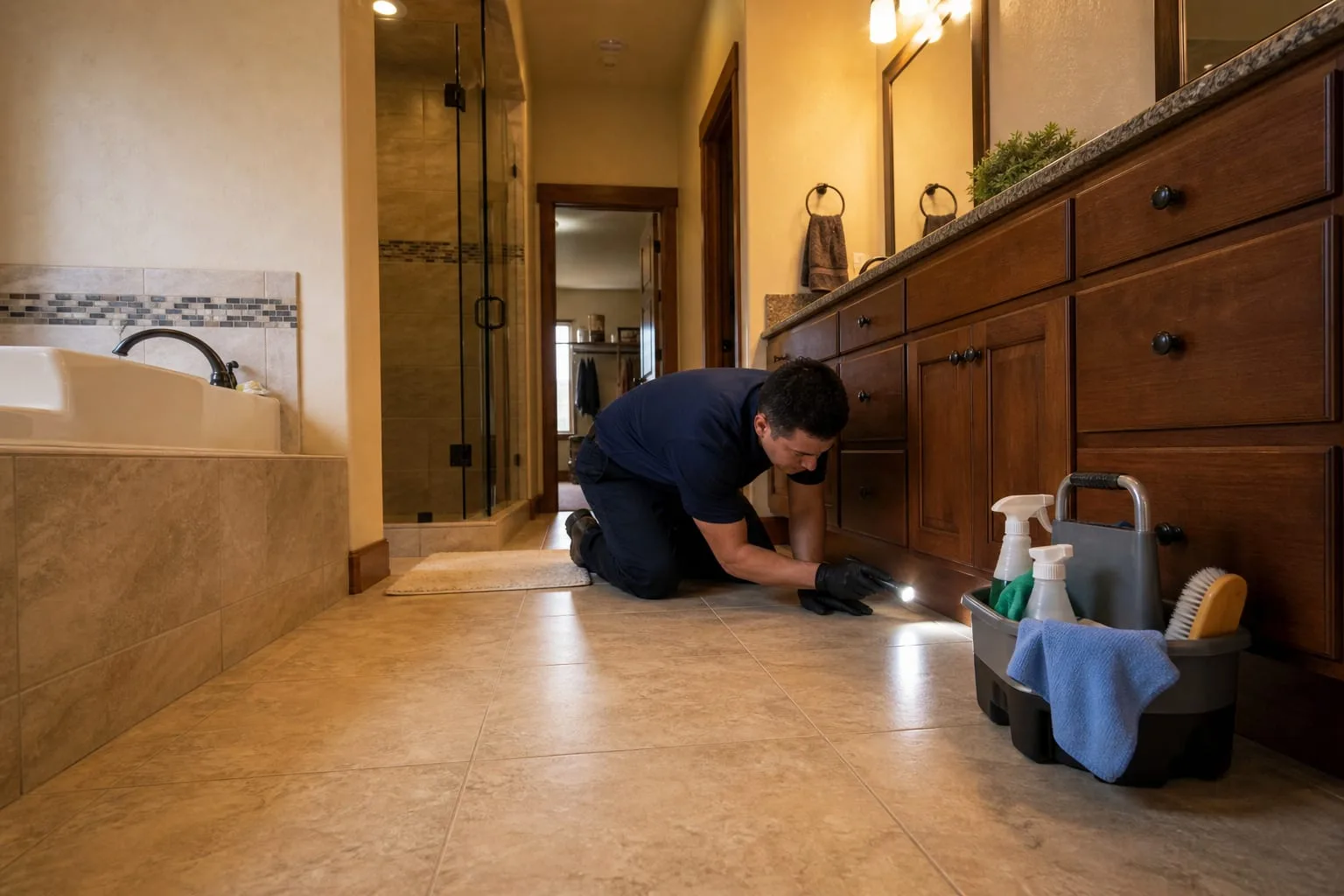
The person who finds a problem first is almost never the person who pays for it. In a house, that person is usually holding a mop. I spent an afternoon with Marisol Vega, who runs a janitorial and light-maintenance crew servicing residential turnovers and a handful of small commercial suites, because she keeps saying the same thing to me in different words: her crews walk past the beginning of every expensive repair in the region, weekly, and are asked about roughly none of them. The conversation was about money, specifically the difference between what a thing costs on Tuesday and what the same thing costs eight months later.
The party nobody in the transaction thinks to ask
Vega's framing is blunt. A homeowner sees a bathroom for ten minutes a day in bad light and with their mind elsewhere; an inspector sees it once, at purchase, under time pressure; a plumber sees it only after something has already failed. Her technician is on hands and knees at the base of the toilet every other week with a light, and knows exactly which caulk line went soft in March and which one has been soft since last year. That knowledge sits in a person who has no contractual reason to volunteer it and no standing to be believed if they do.
The fix she recommends costs nothing and takes a sentence. Ask the crew to report, in writing, anything that changed since the last visit, and tell them you want the trivial items too. Vega says the moment a client asks for that, the reports arrive, and they arrive with detail: which grout joint is now taking a fingernail, which cabinet floor is tacky, which vent is throwing more lint than it did. She has clients who moved from reactive repairs to scheduled ones purely on the strength of a note field added to an existing invoice.
What compounding actually looks like
She resists the word neglect, because in her experience almost nobody neglects anything on purpose. What happens is that a maintenance item stays cosmetic for a long stretch and then crosses into structural in a short one, and there is no announcement at the crossing. A failed shower caulk line reads as an appearance problem for a year while it wets the subfloor behind the tile. A condensate drain that backs up twice reads as a nuisance until the pan overflows into a ceiling. The cost curve is not a slope, she says. It is a step.
Her examples all share a structure worth naming. A surface fails first, which is cheap; then the substrate under the surface absorbs, which is moderate; then something biological or electrical joins in, which is where the number stops being predictable. The Environmental Protection Agency is the federal body responsible for indoor air quality and moisture guidance, and Vega's crews are trained to treat any persistent damp smell as a stop-work-and-report item rather than something to be masked, because the difference between drying a cabinet base and remediating one is the difference between a visit and a project.
What drives the number, and what does not
I asked her what actually moves the price when the same repair is quoted twice. She listed four things, none of which is the material. Access is first: whether the failure can be reached through a door or requires opening a wall, moving an appliance, or cutting a ceiling. Secondary damage is second, meaning how many trades the job now needs, because a single plumber is one invoice and a plumber plus a drywall crew plus a painter is three. Timing is third, since emergency response carries a premium and a scheduled visit does not. Documentation is fourth.
That last one surprised me until she explained it. When a homeowner can show the date a stain appeared, the date it was reported, and what was done, the conversation with an insurance adjuster is short, and the conversation with a contractor is specific. When they cannot, everyone prices in uncertainty, and uncertainty is expensive. A stack of routine service notes is not glamorous, but it functions as a maintenance record, and a maintenance record is the thing that separates sudden damage from a long-term condition in a claim file.
When the second look is worth paying for
Vega and I agree on the trigger. Pay for an independent inspection, from someone with no repair work at stake, when two things coincide: a symptom has recurred, and the person offering to fix it is also the person diagnosing it. That is not an accusation, it is arithmetic. The remedy is to hire eyes that are paid only for looking.
Tell the inspection what to look for rather than commissioning a general survey, because a general survey returns a general report. Give the inspector the crew's notes and ask for four things: moisture readings at the specific locations named, the source of the water rather than the evidence of it, whether the substrate is compromised or merely wet, and a written scope of repair specific enough to be bid by three contractors without further questions. Ask for photographs with dates. That report, in Vega's experience, pays for itself on the first bid comparison.
The useful shift is small. Treat the crew already in the building as part of the transaction, give them a place to put what they notice, and the expensive step in the cost curve gets caught while it is still a surface.