Surface Dry on Day Three, Musty on Day Nine? How Fast Drying and Proper Drying Diverge
Restoration drying became an equipment business measured in days, which is why a floor can read dry while the wall cavity behind the baseboard is still holding water.
Enzo Battaglia5 min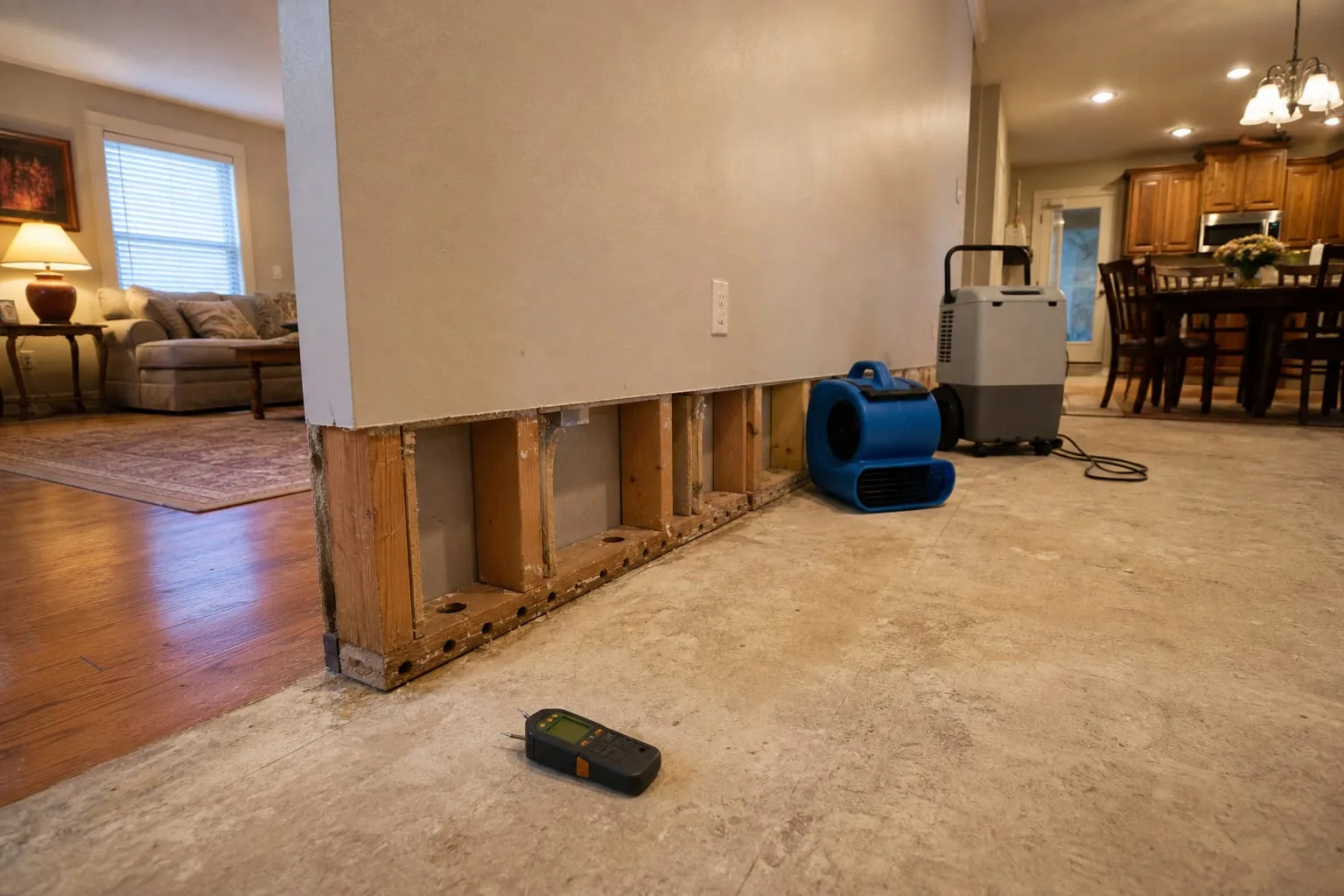
The room feels fine. The carpet is no longer cold underfoot, the drywall looks like drywall again, and the crew came back on the third morning, pulled the fans, coiled the cords, and told you the readings were good. Then, sometime in the second week, there is a smell near the baseboard on the wall that took the worst of it, faint and slightly sweet, the kind you notice at night and not in the afternoon. Nothing has failed visibly. Something is still wet, and the question is what, and how deep.
How drying turned into an equipment business measured in days
For a long stretch of the trade's history, drying a wet house meant opening windows, running box fans, and waiting for the weather to cooperate, which in a humid August it does not. Refrigerant dehumidifiers changed the arithmetic by making the air itself a place to dump water, and low grain refrigerant units extended that into the range where wood and plaster will actually release moisture rather than simply hold it. Air movers came next, aimed along surfaces to break the saturated boundary layer. The physics got better. So did the billing.
What followed was a pricing structure that nobody designed on purpose but everybody now works inside: equipment billed per piece per day, labor billed for placement and pickup, and an adjuster reviewing the invoice who has seen a thousand of them and knows roughly how many days a comparable loss usually runs. That structure quietly rewards two opposite behaviors. A crew can leave equipment running longer than the building needs, or it can pull equipment on the day the surfaces read dry and the file looks tidy. Both show up as a defensible number of days.
The trade's own answer to that pressure was documentation. Drying is supposed to be governed by a dry standard, meaning readings taken from unaffected material of the same type elsewhere in the house, and by a daily log that shows moisture content falling toward that standard rather than stalling. The Environmental Protection Agency is the federal body whose remit covers mold in buildings and the moisture conditions that let it start, and its framing is the useful one for a homeowner: the goal is not a dry-feeling room, it is material that no longer supports growth.
What the ordinary week actually looks like
Day one is the loud day. Extraction, demolition of anything obviously unsalvageable, base trim off, holes drilled at the bottom plate if the cavity took water, and equipment set with a rough plan for how many cubic feet the dehumidifiers have to hold. Day two is usually the steepest drop, because free water leaves fast and the readings reflect it. Day three is where the two approaches separate. Surface readings on drywall and finish flooring often look close to normal by then, and a crew working toward a target date will read that as arrival.
A crew working toward a dry standard reads day three as the beginning of the slow part. Bound water inside framing, subfloor plywood, plaster keys, and the paper facing behind a vapor retarder leaves on a curve that flattens, so days four through seven produce small decreases that look like nothing on a chart and matter enormously in a wall. This is also the week when the household is most impatient, the noise is intolerable, the electric bill is climbing, and somebody asks whether the last two units are really necessary. That is the conversation where houses get shorted.
Where quick drying and proper drying genuinely diverge
The divergence is almost always about assemblies rather than rooms. An open room with tile over slab dries quickly and honestly, because there is little to trap. The trouble sits in layered construction: engineered flooring over an underlayment over a subfloor, an exterior wall with insulation and a poly vapor retarder that stops drying in the direction you want it to go, a kitchen toe kick, a stair stringer, the bottom eighteen inches of a finished basement partition. Each of those holds water behind something that reads dry from the face.
Fast drying handles those by hoping, and sometimes hoping is correct. Proper drying handles them by creating a path, which means cutting an inspection opening, drilling the plate, removing a section of underlayment, or pulling a cabinet base, and then measuring inside rather than outside. The cost difference on the invoice is often modest. The cost difference in outcome is a wall you never think about again versus a wall that is opened up eleven weeks later, when the claim file is closed, the deductible is spent, and the conversation about who pays has no obvious ending.
The second look, and what to tell the person doing it
An independent moisture inspection is worth paying for at one specific moment, which is after the crew proposes pulling equipment and before they actually do it. At that point an inspector can still be right about something correctable, and the equipment is still in the house. Later, a second look becomes a forensic exercise about causation, which is more expensive, more adversarial, and much less likely to produce a dry building. The whole value of the second opinion is that it lands while the answer is cheap.
Tell the inspector three things to look for rather than asking for a general opinion. First, pin meter readings taken in the framing and bottom plate through existing openings, compared against a dry standard from the same species elsewhere in the house, with the comparison values written down. Second, the daily log from the restoration contractor, read for whether readings actually fell or simply stopped being recorded. Third, the assemblies specifically: under flooring, behind toe kicks, inside the cavity, at any point where two materials meet and one of them is wood.
Ask for the findings in writing with locations, values, and dates, because that document does double duty. It either releases the crew to finish and gives you a clean record that the building reached standard, or it gives your adjuster a concrete reason to keep two dehumidifiers running four more days, which is a far easier request to approve than a homeowner's impression that something still smells wrong.
The trade got very good at drying quickly, and that skill is real; the equipment and the physics both work. What the week-to-week rhythm of a claim does not naturally supply is the person whose only job is to ask whether the inside of the wall agrees with the outside of it. That person costs one visit, and the visit is worth scheduling on the morning the fans are about to leave.