Storing Stock Somewhere Else? What Your Customer Notices When the Handoff Is Sloppy
Self-storage, a third-party warehouse, or marketplace fulfillment: the differences show up at the buyer's doorstep long before they show up on your invoice.
Greta Holmqvist4 min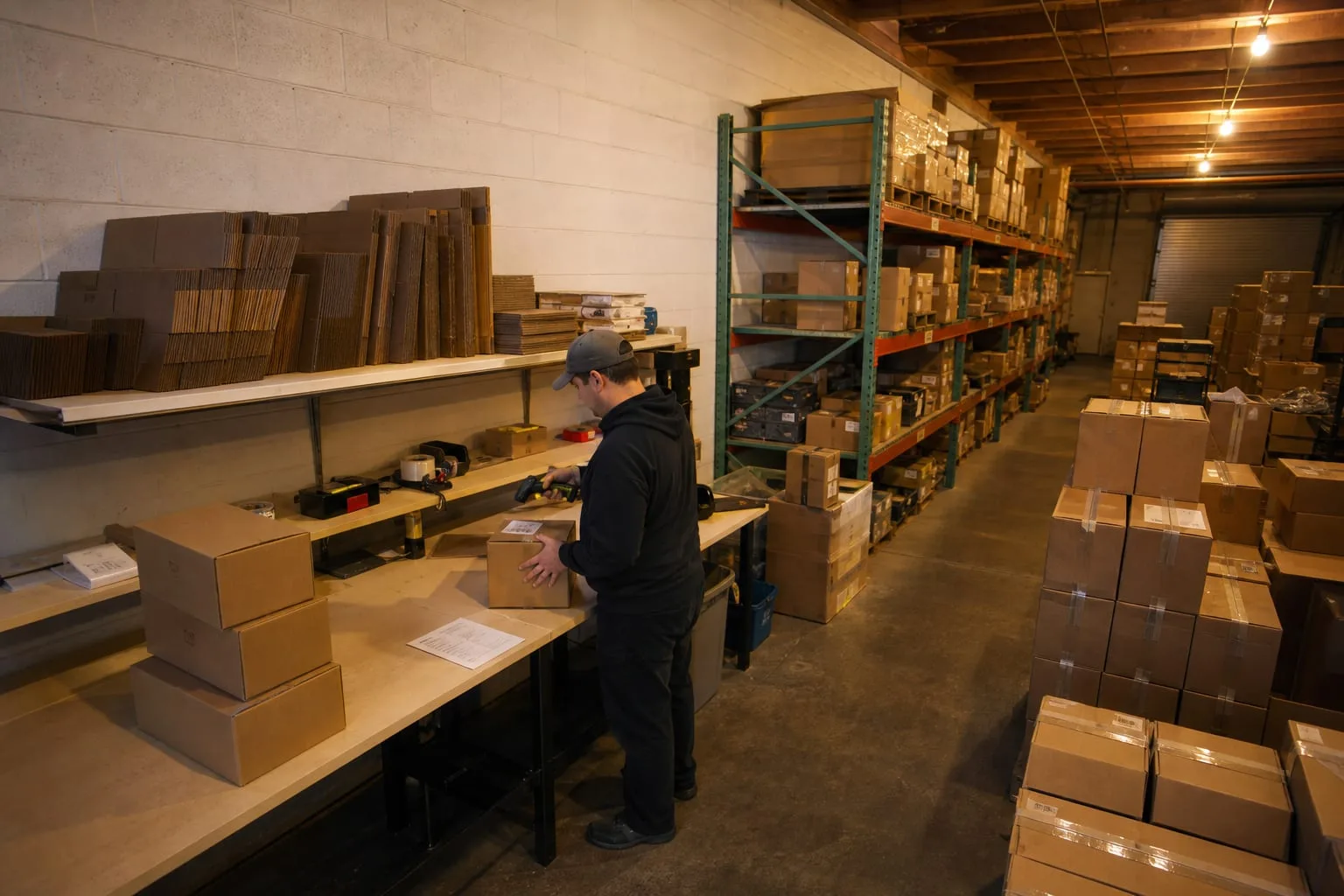
The decision usually arrives as a space problem. The spare room is full, the garage has stopped being a garage, and picking orders after dinner has quietly become a second job. What gets compared at that point is rent per square foot and pick fees, which is reasonable, because those are the numbers on the page. But the thing you are actually buying is a stranger's experience of opening a box, and that experience is decided by details that never appear in a quote: cutoff times, how a short pick is handled, whether anyone answers when a customer emails about a package that stalled in Memphis.
Three places your stock can sit, and what each does to the doorstep
A self-storage unit plus your own labor is the cheapest arrangement and the most honest one, because every failure is yours to see. You know when a box went out with the wrong size in it, you know the day you skipped the post office, and you can fix both. What you cannot do is scale past your own evenings, and the customer feels that as variable speed: two days one week, six the next, with no explanation offered. Buyers tolerate slow far better than they tolerate unpredictable, and a one-person operation running out of a unit tends to be both.
A third-party logistics provider, a 3PL, sells you a receiving dock, racked storage, and someone who picks and packs on a schedule. The good ones behave like a department you happen not to employ, with a named contact, a daily cutoff you can publish on your own site, and inventory counts that match reality closely enough that you can sell down to the last unit. The barely adequate ones are warehouses that took on ecommerce as a sideline. From the customer's side the difference shows up as a tracking number that is generated on Tuesday and does not physically move until Friday.
Marketplace fulfillment, where the platform stores and ships for you, buys you delivery speed and a badge that measurably moves conversion. It also puts a wall between you and the buyer. When something goes wrong, you find out from a review rather than an email, and the resolution follows the platform's policy rather than your judgment. For a business whose products are broadly interchangeable with competitors, that trade is often worth making. For anything fragile, seasonal, or explained on the packing slip, it usually is not.
Cutoff time is the promise, not the marketing copy
Ask any prospective provider for one number: the hour by which an order must land in their system to ship the same business day. Then ask what happens to an order that arrives at eleven minutes past. A good operation answers immediately, with a time and a rule, because the whole floor is built around it. A weak one answers in ranges, says it depends on volume, and mentions that they usually get to things quickly. That vagueness is not modesty. It is the sound of a warehouse that batches work whenever a person becomes free, and every hour of drift lands on a buyer who was told two to three days.
The stakes here are not purely reputational. The Federal Trade Commission oversees how sellers represent shipping times to consumers and what has to happen when an advertised window is missed, which means the ship date you publish is a commitment rather than an aspiration. A provider who cannot tell you their own cutoff cannot help you keep yours. Get the number in writing, along with the cutoff for expedited services, which is frequently earlier and frequently omitted.
What a good pick looks like from the customer's side
Barely adequate fulfillment is recognizable in the box. Correct item, wrong quantity of the free sample, a void filled with three feet of air pillow above a small heavy thing that has spent four days migrating around the carton, no packing slip because the integration does not pass one. None of that is catastrophic on its own. It compounds. The customer who receives a bruised box with no paperwork writes to ask whether anything is missing, and you spend twenty minutes reassuring someone who would have needed nothing had a slip been in the carton.
A good provider will show you their scan rate, meaning how often a picker verifies a barcode against the order rather than relying on recognition, and will tell you their mispick rate without being pushed. They will also say what happens when the shelf is empty: whether the order sits silently, ships short, or triggers a message to you within the hour. That last policy is worth more than a few cents of difference in the pick fee, because a short ship discovered by the buyer costs you the reorder, and a short ship flagged in an hour costs you an apology email.
Returns, and the small job nobody prices
Returns processing is where the gap between options is widest and least discussed. Some providers inspect, restock, and credit within a couple of days. Others quarantine returns in a corner and process them monthly, which means saleable stock is invisible to your storefront for weeks and refunds get delayed while you wait on confirmation. Ask for the turnaround in days, ask who decides whether an item is resaleable, and ask what a return costs, because it is often billed as a full receiving event rather than the two-minute task it usually is. Bundle it into the contract discussion rather than discovering it on the third invoice.
The useful comparison is not cost per order. It is what each arrangement does on a bad day, when a shelf is short, a carrier misses a scan, and a buyer wants an answer by lunchtime. Price the good day if you like, but choose on the bad one.