Small Repairs Got Expensive and Your Dwelling Limit Did Not. Where Averaging Bites
Under-insurance rarely starts with a big decision; it starts with the rising cost of small jobs, and the averaging clause is where the gap finally shows up.
Greta Holmqvist5 min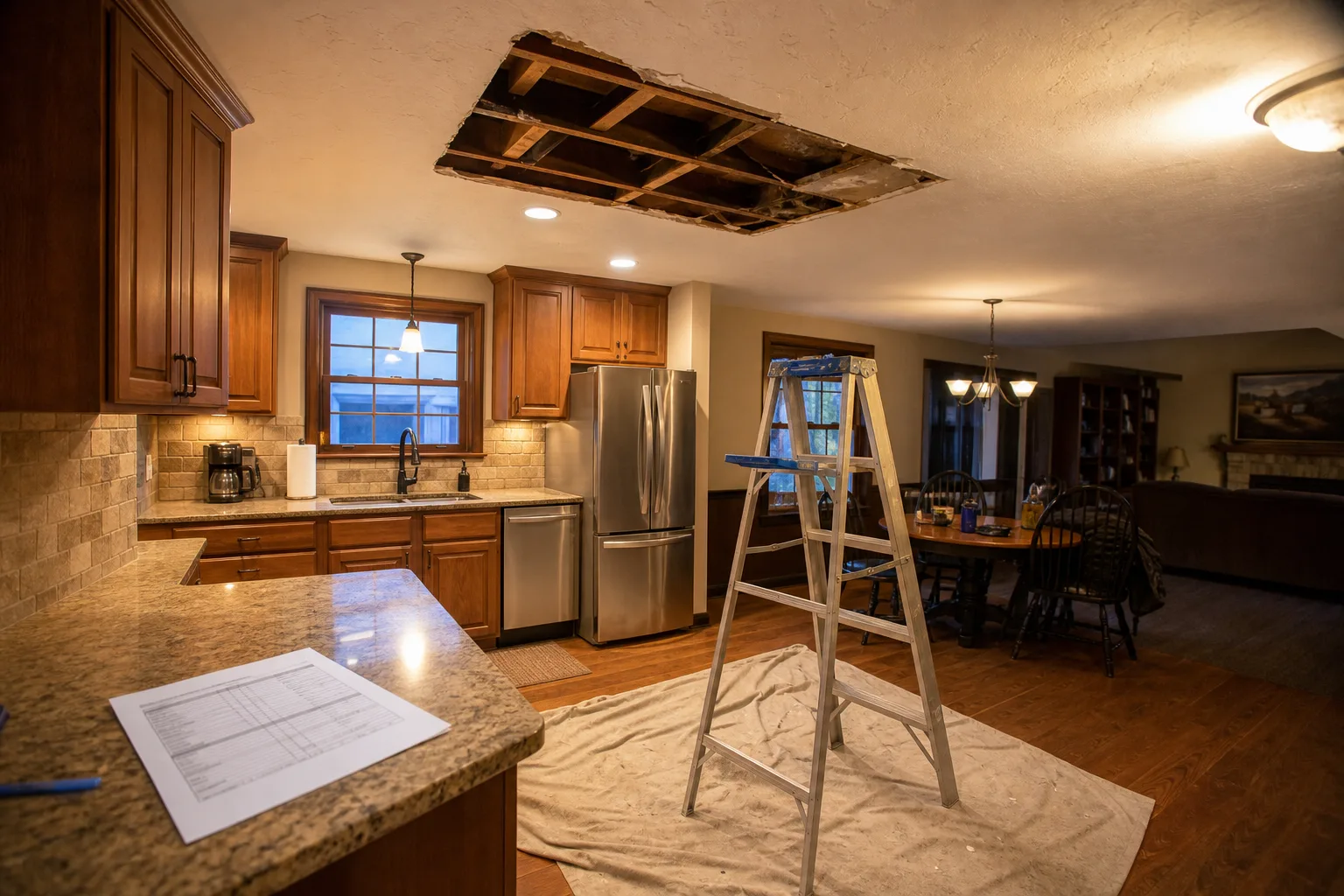
The first sign is almost never a denial. It is a check that clears, covers most of the repair, and stops several thousand dollars short of the contractor's estimate, with a line on the settlement worksheet naming a percentage nobody explained at renewal. The adjuster is not freelancing. Somewhere in the declarations is a condition tying full payment to insuring the building for a stated share of what it would cost to rebuild, and when the limit falls below that share, the policy pays a fraction of even a small loss. The gap rarely arrives in one bad decision.
The drift starts with the two-hour job, not the rebuild
Most people picture under-insurance as a total-loss problem: the house burns, the limit is four hundred thousand, the rebuild is five twenty. That version exists, but the arithmetic that creates it is built out of small work. A plumber who will not leave the shop for less than a minimum charge, a drywall patch that carries a mobilization fee because it is two hours of work in a half-day slot, a roofer who prices a six-square tear-off at a per-square rate that assumes he is there all day anyway. Those minimums are the real inflation, and they compound.
Rebuild estimating software reads that same labor market. When the going rate for a short, awkward, one-trade visit rises, so does the cost of the hundreds of short visits that make up a reconstruction: the electrician back for trim-out, the tile setter returning for a threshold, the painter's third trip. A house does not get rebuilt by one crew in one pass. It gets rebuilt by a sequence of small jobs, each carrying its own setup cost, and that is the number an inflation guard of two or three percent a year was never designed to track through a period when scheduling itself became the scarce good.
So the limit drifts quietly. Nobody chose it. It was set at purchase, nudged upward annually by a percentage picked before the local trade market tightened, and never rechecked against what a contractor would actually charge to put the same structure back, at current code, on a street where every other house is also waiting for the same three subcontractors.
What the averaging clause actually does to a small claim
The condition goes by several names: coinsurance on commercial property, an insurance-to-value or replacement cost condition on a dwelling. The mechanics are consistent. The policy sets a required share of full replacement cost, commonly eighty percent, and compares your limit against that requirement at the time of loss. Carry less, and the payment is reduced in proportion, so a limit at three quarters of the required amount pays roughly three quarters of the covered repair, minus the deductible, on a kitchen fire that was never going to approach the policy limit in the first place.
That is the part homeowners find hardest to accept. The penalty is not reserved for catastrophic losses; it applies to the four-thousand-dollar ceiling repair as readily as to the rebuild, and the smaller the claim, the more the proportional cut looks like an arbitrary haircut. On dwelling policies the same idea often appears as a settlement-basis switch rather than a stated percentage: fall under the required insurance-to-value and the loss settles at actual cash value, depreciated, instead of replacement cost. Different wording, same outcome, and it is decided at the moment of loss rather than at renewal.
The one genuinely good piece of news is that the test is arithmetic, not judgment. It can be run in advance, by you, on a quiet evening, with the declarations page and a current replacement cost estimate. Nothing about it is a surprise except the timing.
The local rulebook sets the size of the cushion
How much room you need above the naive rebuild figure is a regional question, and this is where national rules of thumb fail. Reconstruction has to satisfy the code in force now, not the code the house was built to, and that delta varies enormously by jurisdiction. A county that adopted a recent wind standard may require a sealed roof deck, engineered connectors and new opening protection on a rebuild. A seismic jurisdiction may require foundation bolting and cripple wall bracing. Northern counties enforce ice barrier and insulation requirements that were not on the books when the house was framed.
Those upgrades are paid for by ordinance or law coverage, which is typically a small percentage of the dwelling limit and therefore shrinks in lockstep with any under-insurance. Wind and hurricane deductibles compound the same way, because they are usually written as a percentage of the dwelling limit rather than a flat dollar figure, so a limit that is low for rebuild purposes also produces a deductible that is low in dollars and pleasant to look at, right up until the point where the settlement is being reduced anyway. Flood sits outside all of it. Coverage written through the National Flood Insurance Program, which the Federal Emergency Management Agency is responsible for, carries statutory limits that can sit below the replacement cost of a mid-range house, which is why excess flood coverage is a routine purchase in some coastal and riverine markets and unheard of two states inland.
State rules layer on top. Departments of insurance differ on what an insurer must disclose about replacement cost estimates, how extended and guaranteed replacement cost endorsements may be described, and what notice you get when an inflation factor changes. Your state's department is the place to confirm which of those protections you actually have.
Building the judgment, then keeping it current
The workable habit is narrow. Once a year, before renewal rather than after, get a replacement cost figure that is not simply last year's figure times an index: a contractor's per-square-foot number for your construction type in your market, or the insurer's own estimator run with accurate inputs on roof covering, framing, foundation type and finish level. Then divide your dwelling limit by that figure and read the percentage against the condition in your policy. If it lands near the threshold, raise the limit, because the test is applied to the number in force on the day of the loss and small remodels move the denominator.
Ask three things in writing. What percentage does this policy require, what does ordinance or law coverage pay as a dollar amount rather than a percentage, and does the extended replacement cost endorsement apply if the insurance-to-value condition was not met. Written answers travel to the adjuster's file better than remembered ones.
Keep the paper trail small and specific: the estimate, the date, the endorsement numbers. A folder that holds four pages is a folder that gets updated, and the year you need it, it will already be sitting in the right place.