Your Renewal Added Three Exclusions and Nobody Called. What to Have Someone Read
Homeowners policies now carry exclusions bolted on at renewal rather than written into the base form, and a paid second read before the renewal date is the cheapest way to find them.
Enzo Battaglia6 min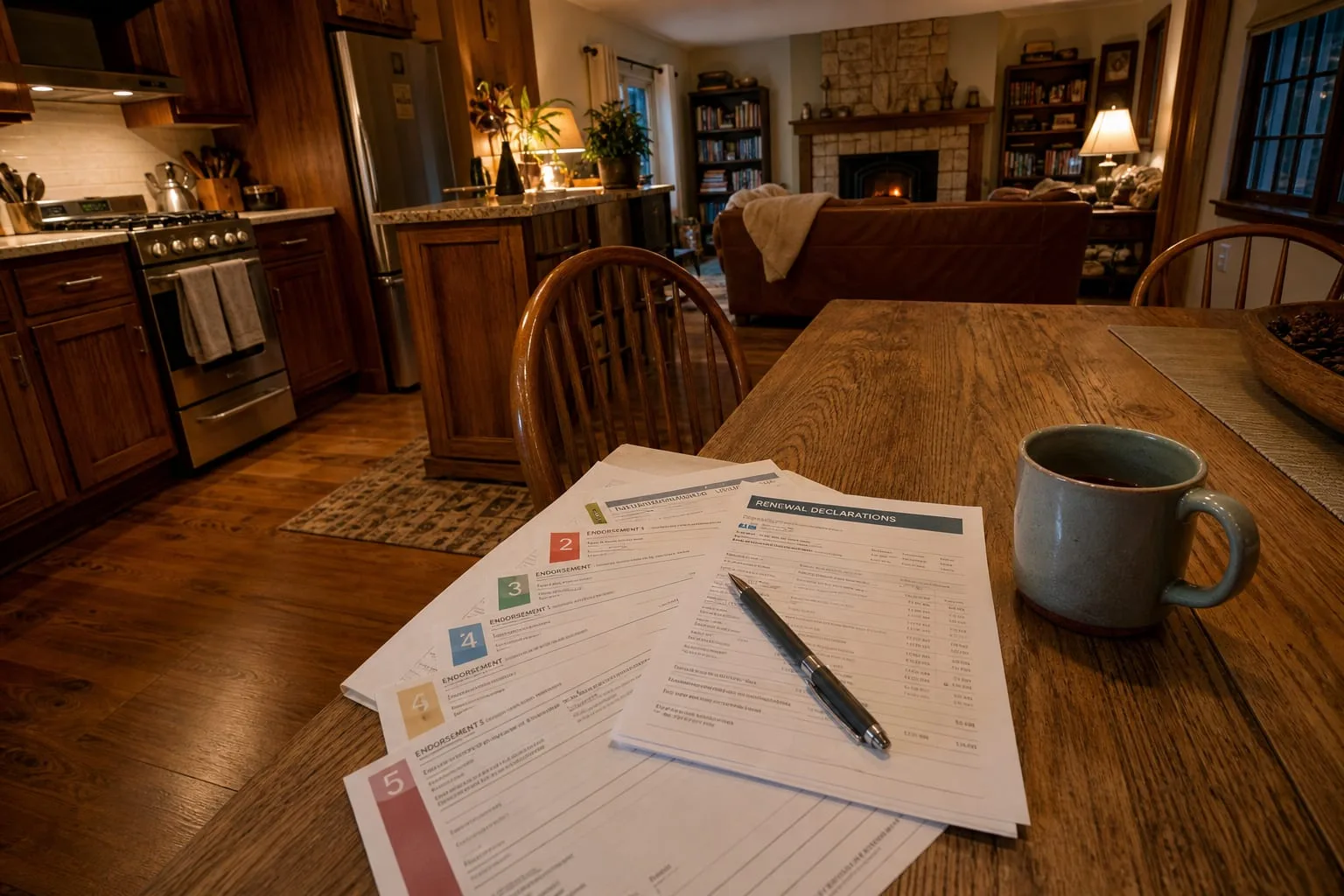
Ten years ago, comparing two homeowners policies was mostly an exercise in comparing two numbers, because the coverage forms underneath them were close enough that the premium and the deductible carried the decision. That is no longer true in most states. The base form still reads much as it did, but what sits on top of it, the endorsement pages that get added at renewal and mailed with the declarations, is where the actual coverage now gets decided. A household that renews without reading those pages is not buying the policy it bought last year, and the difference does not show up until a claim.
The exclusion moved out of the policy and into the renewal packet
The old habit was to treat the policy form as fixed and the price as the variable. An agent quoted, you compared, and the exclusions were the standard ones every carrier used: wear and tear, earth movement, flood, neglect, war. They were printed in the same place in every form and they rarely changed from one year to the next. What has shifted is the mechanism. Carriers now adjust their exposure by attaching endorsements at renewal rather than by rewriting the form or refiling the whole product, which means your coverage can narrow substantially while your policy number, your agent, and your carrier all stay the same.
That matters to a household in a specific and unglamorous way. The renewal packet arrives thirty or forty-five days before the effective date, it is thick, and the cover letter usually says the premium changed and nothing else. The endorsement that limits roof payments to actual cash value, or the one that excludes cosmetic hail damage to metal surfaces, or the one that caps water damage from plumbing at a dollar figure well under the cost of a real loss, is inside that packet as a numbered form. No phone call accompanies it. The renewal is accepted by paying, which is why so many are accepted unread.
There is a fair version of this story too. The endorsement mechanism is why coverage still exists at a price most households can pay in places where the loss history would otherwise have driven carriers out entirely. An exclusion is a carrier saying which risk it will not price, and the honest response is not outrage but arithmetic: find out which risk was handed back to you, decide whether you can absorb it, and if you cannot, go buy it somewhere else or fix the underlying condition. That decision is available to you. It is only unavailable if you do not know the endorsement is there.
The roof is where most of the movement happened
If one component explains the last decade of endorsement activity, it is the roof. Ten years ago a twenty-year-old asphalt roof damaged by hail was, in a great many policies, replaced at full cost minus the deductible. Now the same roof is frequently covered on a schedule that pays a depreciated percentage based on age, or on actual cash value with no path to recovering the difference, or with a separate percentage deductible for wind and hail that runs into thousands of dollars on an average house before anything is owed. Three different endorsements, all common, all producing very different checks for the same storm.
Alongside those sits the cosmetic damage exclusion, which pays for a roof that leaks and declines to pay for one that is dented, scarred, or granule-stripped but still shedding water. Reasonable people disagree about whether that is a fair line, and the practical problem for a household is that the line is drawn by an adjuster standing on the roof after the storm, working from photographs and a moisture reading, not by anyone you hired. The matching question sits next to it: whether the carrier owes you a whole slope, or a whole roof, when the discontinued shingle it damaged cannot be bought anymore.
Water arrives through three separate doors, and only one of them is open
Water is the loss most households actually have, and it is the loss where the exclusions are most carefully partitioned. Water rising from outside the house, whether from a river, a storm surge, or a street that could not drain, is flood, and it has been excluded from standard homeowners policies for decades. That coverage is bought separately, and the National Flood Insurance Program, administered by FEMA, is the mechanism most households use for it. Nothing new there. What is new is how narrow the other two doors have become.
Water backing up through a drain or overflowing a sump is excluded in the base form and returned to you by endorsement, usually with a sublimit you choose, and the sublimits sold by default are often far below the cost of finishing a basement twice. Water escaping from plumbing inside the house is generally covered when it is sudden, and generally not covered when it has been going on quietly, with a growing number of policies now naming a specific window, fourteen days is common, after which continuous seepage stops being a covered loss and starts being maintenance. A household that travels, or that has a rental unit or a second floor nobody walks through, has an exposure there worth pricing.
The useful reframe is that these are three distinct products, not three parts of one. Knowing which of the three a given failure falls under, before it happens, tells you which endorsement to buy and which condition to fix. Households that go through this exercise usually find that the fix is cheap: a backwater valve, a battery sump backup, a leak sensor near the water heater, a supply line replaced with braided stainless. The exclusion stops mattering as much once the loss it describes has been engineered out of the house.
What a second read is worth, and what to tell the person doing it
This is the part I argue for. Somebody who is not selling you the policy should read the policy, and the right time is when the renewal packet lands, not when the water is on the floor. That can be an independent agent who does not write for your current carrier, a licensed public adjuster doing a pre-loss policy review, or a coverage attorney billing an hour. The cost is modest against the exposure, and the output should be written, because a verbal reassurance from someone who skimmed the declarations page is worth nothing when a claim gets denied eighteen months later.
Give the reviewer a list of questions rather than asking for a general opinion, because a general opinion comes back as "looks standard." Ask what the roof is paid on, replacement cost or actual cash value, and whether a payment schedule by age applies. Ask whether cosmetic damage is excluded and for what materials. Ask what the wind and hail deductible is in dollars, not percent, on the current dwelling limit. Ask whether water backup is endorsed and at what sublimit. Ask whether there is a continuous seepage time limit and how long. Ask what changed from last year's endorsement list, which is the single most valuable question and the one nobody asks.
The same discipline applies to the house itself. An independent inspection, ordered by you rather than by a buyer or a carrier, is the document that establishes condition before a loss, and condition is what most denials turn on. Tell the inspector to photograph and date the roof surface, the age and type of every water supply line, the water heater and its pan, the grading at the foundation, and any existing staining. That file is what answers an adjuster who suspects a leak predates the claim. It costs a few hundred dollars and it is the closest thing a household has to a rebuttal witness.
An exclusion is not an accusation and it is not a trap. It is a boundary, and boundaries are only dangerous when they are invisible. Read the renewal packet in the month it arrives, pay someone independent to read it with you the first year, and the second year you will know exactly which pages to turn to and which questions to put to your agent before you pay.