Reading Your First Policy? How to Tell Which Exclusions Are Standard and Which Are Not
An exclusion is not a random denial written by your carrier; most of them are filed, approved and traceable, and knowing which is which changes what you can do about it.
Enzo Battaglia4 min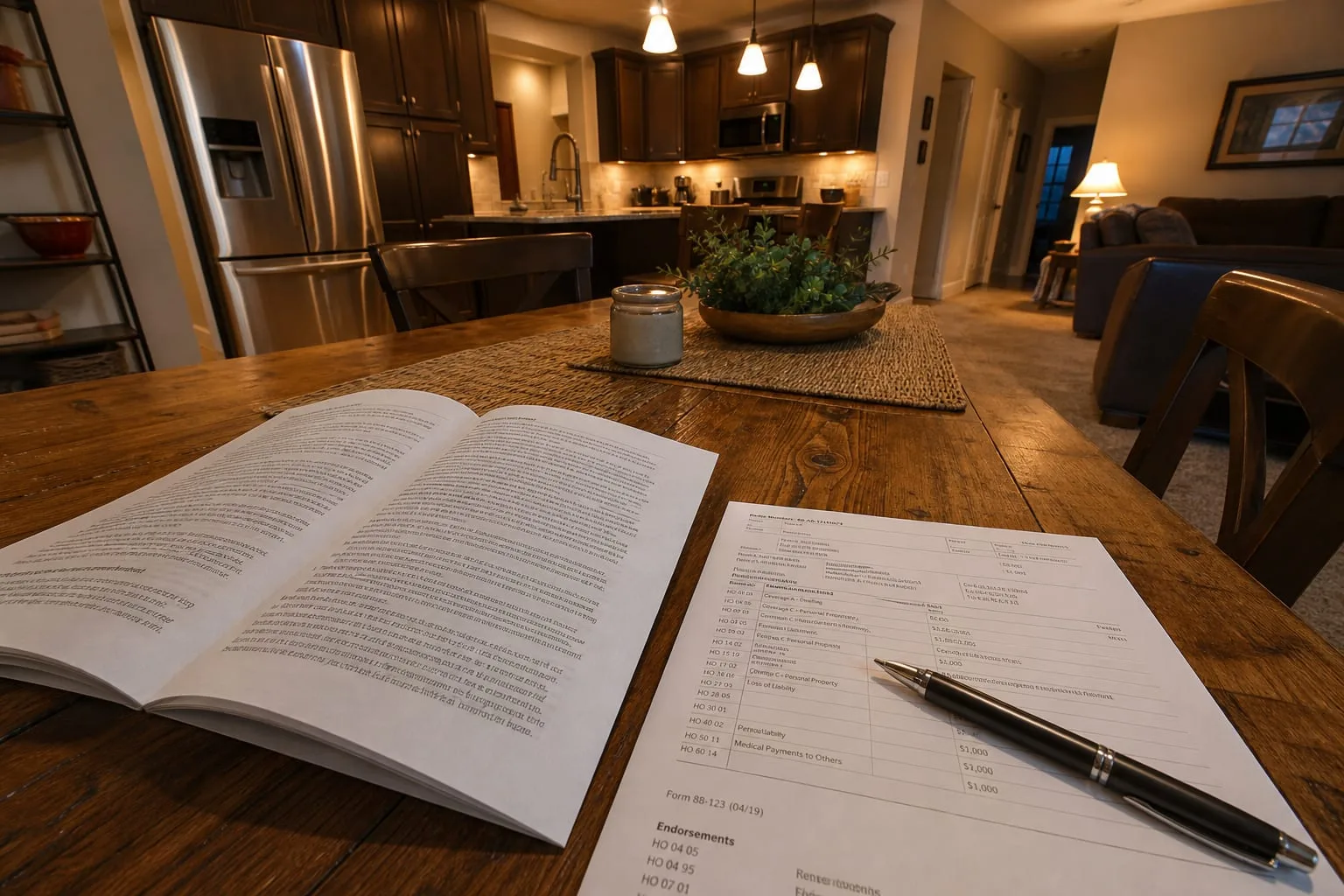
The first time someone reads a homeowners or landlord policy end to end, it is usually because a claim is already in motion and an adjuster has used a word they did not recognize. That is the worst possible moment to learn how the document is built, because the reading is now adversarial and the clock on your proof of loss is running. The better moment is the week the policy arrives, when nothing is wrong and the only cost of understanding it is an hour. What follows is the order I would work in, and the point at which paying someone else to look is worth the money.
Find the form number before you argue with the sentence
Every exclusion in your policy came from somewhere, and the somewhere is printed in small type at the bottom of the page or in the corner of the first sheet of each section. A base policy carries a form number and an edition date. Each endorsement attached to it carries its own. Your declarations page lists them all, usually in a block that most people skim past on the way to the premium. Copy that list out. The distinction that matters more than anything else in the document is whether a given exclusion sits in the standard form that thousands of households in your state received, or in an endorsement your carrier added to your policy in particular.
That distinction tells you what kind of problem you have. A standard exclusion is an industry-wide allocation of risk, and arguing that it should not apply to you is generally a losing position. An endorsement, on the other hand, was attached for a reason: a prior claim, an underwriting inspection, the age of the roof, a dog, a pool, a wood stove. Endorsements can often be removed once the underlying reason is cured, and the carrier will not volunteer that. Knowing which page you are looking at is the difference between a negotiation and a lecture.
Somebody approved that wording, and it was not your agent
Policy forms sold to consumers are not free text. In every state, the department of insurance regulates the forms carriers may use, and in most lines the form and its exclusions have to be filed with that department, and in many cases approved, before a single policy is issued on it. Many states also impose readability requirements on personal lines contracts, which is why the modern homeowners form uses short defined terms in quotation marks rather than the dense paragraphs of thirty years ago. Flood is the clearest illustration of how much of this sits outside your carrier: the near-universal flood exclusion exists because that peril is written through the National Flood Insurance Program, which the Federal Emergency Management Agency oversees.
Two practical things follow. First, your state department of insurance can usually tell you whether a form is on file and can accept a complaint about how it was applied, which is a free channel most first-time policyholders never use. Second, an exclusion that appears in the filed standard form is not evidence that your carrier is unusually restrictive, and you can stop reading it that way. What deserves your attention is the endorsement page, the one that names a specific structure, a specific peril, or a specific dollar sublimit that differs from what the base form promised.
How the sentence gets read when two people disagree
Insurance contracts are interpreted under rules that developed precisely because one party wrote every word. The insurer generally bears the burden of proving that an exclusion applies, while you bear the burden of showing the loss falls within the grant of coverage in the first place. Genuine ambiguity in an exclusion is usually construed against the drafter, which is the carrier. Courts in many states also give weight to the coverage a reasonable person would have expected from how the policy was sold. None of that makes an exclusion optional, but it does mean the adjuster's reading of a clause is an opening position rather than a verdict.
The clause worth locating early is the anti-concurrent causation language, which typically sits just above the exclusion list and says that a listed cause defeats coverage even where a covered cause contributed. That one sentence decides an enormous number of mixed-cause losses: wind and water together, a pipe that failed because of long-term seepage, a slab that moved because of both a plumbing leak and soil conditions. Read it once now, in daylight, and the eventual conversation about causation will make sense instead of sounding like improvisation.
When to pay for a second look, and what to tell the inspector
An independent second opinion earns its fee in three situations: when an endorsement narrows coverage on the part of the property that would actually be expensive to rebuild, when you are buying a house whose age or systems invite exclusions, and when a claim has been denied on a cause you dispute. For the first two, an independent agent who does not represent your current carrier, or a licensed inspector, is enough. For the third, a public adjuster or a coverage attorney is the right call.
The instruction matters as much as the hire. Do not ask for a general inspection. Ask, in writing, for an opinion on the specific mechanism the exclusion names: whether the water entered above or below grade, whether the cracking is settlement or a defect in the original work, whether the roof failure is age-related deterioration or a single wind event, and what evidence supports the conclusion. Ask for photographs, a date, and a signed report. An inspector told exactly what question to answer produces a document you can put in front of an adjuster; one told to look around produces a document nobody reads.
The hour spent with the declarations page in one hand and the form list in the other is the cheapest hour in the whole relationship, and it converts an exclusion from a surprise into a known boundary you can insure around, cure, or accept deliberately.