Photos, Texts, and an Independent Report. Which of the Three Actually Settles a Dispute?
Most homeowners collect the wrong evidence in the wrong order, and the fix is usually a scoped second look rather than more photographs.
Enzo Battaglia4 min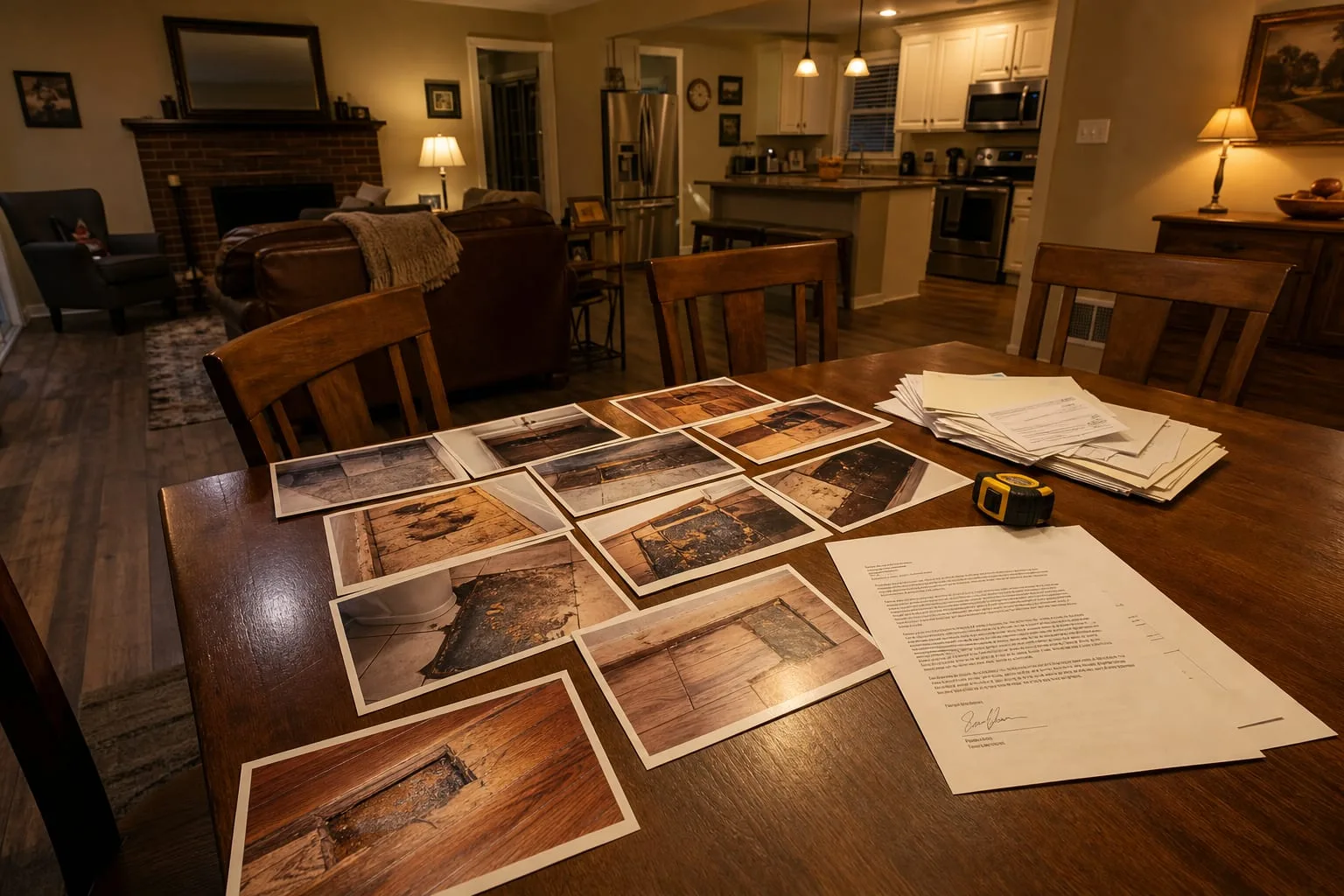
The file that arrives on my desk after a job has gone wrong is almost always thick and almost always thin at the same time. Forty photographs of a stained ceiling, a screenshot of a text thread that starts in the middle, a handwritten page of dates reconstructed from memory three months after the fact. All of it sincere, most of it useless, because nobody told the homeowner what the other side would do with it. Evidence is not a quantity of material. It is a small number of items that survive being read by someone who would prefer they did not.
The photograph that proves nothing, and the one that ends the argument
A photograph of damage is not evidence of cause, and cause is nearly always what is in dispute. I have seen close-up shots of a buckled floorboard used to argue moisture intrusion, improper acclimation, subfloor deflection, and simple abuse, all from the same image, because the frame was tight enough to exclude everything that would decide it. What holds up is a sequence: the wide shot that shows the room and its relationship to the exterior wall, the medium shot that shows the transition where the failure begins, then the close-up with a tape measure or a coin in frame for scale. Shoot the serial plate, the label on the material, the model number on the unit. Shoot the thing that is fine right next to the thing that is not, because the contrast is the argument.
Dates matter more than most people expect. A photograph carries embedded capture data, and that data disappears the moment the image is pasted into a document or texted at reduced size. Keep originals. Send copies. When I ask a client for the original file and receive a screenshot of a screenshot, I know the timeline will be contested and I know we will lose that piece of it.
Contemporaneous beats accurate
A note written the day something happened outranks a more detailed and more truthful account written later, and that ranking feels unjust until you have watched it play out a dozen times. The adjuster, the licensing board, the mediator, the judge: each of them is weighing whether a version was assembled before anyone had a reason to shade it. So the running log is the cheapest evidence available and the one people skip. Date, time, who was on site, what was said, what changed. Two lines is plenty. Email yourself the entry at the end of the day and the timestamp does the rest of the work.
The corollary is that reconstruction should be labeled as reconstruction. If you build a timeline in month four, say so on the document, and cite what each entry came from: a text, an invoice, a delivery receipt, a bank record. A clean chronology with sources attached is persuasive. The same chronology presented as though it were remembered is an invitation to take it apart, and someone will.
What a second look is for, and how to scope it
The single largest improvement available to most people in a dispute is paying an independent inspector, engineer, or licensed trade professional to look at the work and write it down. Not to advocate. To observe. The report from someone with no financial interest in the outcome is the one document that changes the posture of the other side, because it converts your complaint from a dissatisfied opinion into a technical finding that they now have to answer.
It also fails routinely, and it fails for one reason: the inspector was given no scope. Told to "look at the roof," a competent professional will produce a general condition report that says the roof is nearing the end of its service life, which helps nobody. Told in writing to determine whether the step flashing at the chimney was installed under the shingle courses or surface-mounted and sealed, whether the underlayment extends past the drip edge, and whether the observed staining pattern in the second-floor closet is consistent with either condition, that same professional produces two paragraphs you can build a claim on.
So write the assignment as questions. Name the applicable standard if you know it: the manufacturer's published installation instructions, the adopted building code edition, the manufacturer's warranty requirements. Ask for photographs keyed to the findings. Ask explicitly what could not be determined without opening something up, and what it would cost to open it. Ask for the inspector's license number and the basis of their qualification, because the other side will. And do not tell them what you hope they find. A report that reads as though it were ordered to a conclusion is worth less than no report, and every experienced reader spots one in a paragraph.
The paper that surrounds the work
Money leaves a cleaner trail than craftsmanship, and disputes are often decided on that trail rather than on the physical work. The signed proposal with the scope attached, the change orders, the payment schedule, the record of what was paid and when and by what method, the lien waivers, the permit and the inspection sign-offs from the building department. Card and check records establish dates that no one can argue with. Cash payments establish very little, and the gap in the record tends to be read against whoever created it.
The Federal Trade Commission is responsible for consumer protection at the federal level and handles complaints about deceptive practices, so a written complaint filed there, along with one to your state contractor licensing board, becomes part of the record too. File it factually, attach the same evidence, and keep the confirmation.
Build the file as though you will hand it to a stranger who has fifteen minutes. Three photographs that show cause, one dated log, one scoped independent report, and the payment record. That set has moved more disputes to resolution than any volume of material I have ever seen assembled after the fact.