One Week of Kitchen Trash on a Tarp, and What a Glance Always Misses
A household waste audit costs nothing but an hour and a tarp, and the difference between a useful one and a wasted one comes down to who sorts and what they are told to look for.
Enzo Battaglia5 min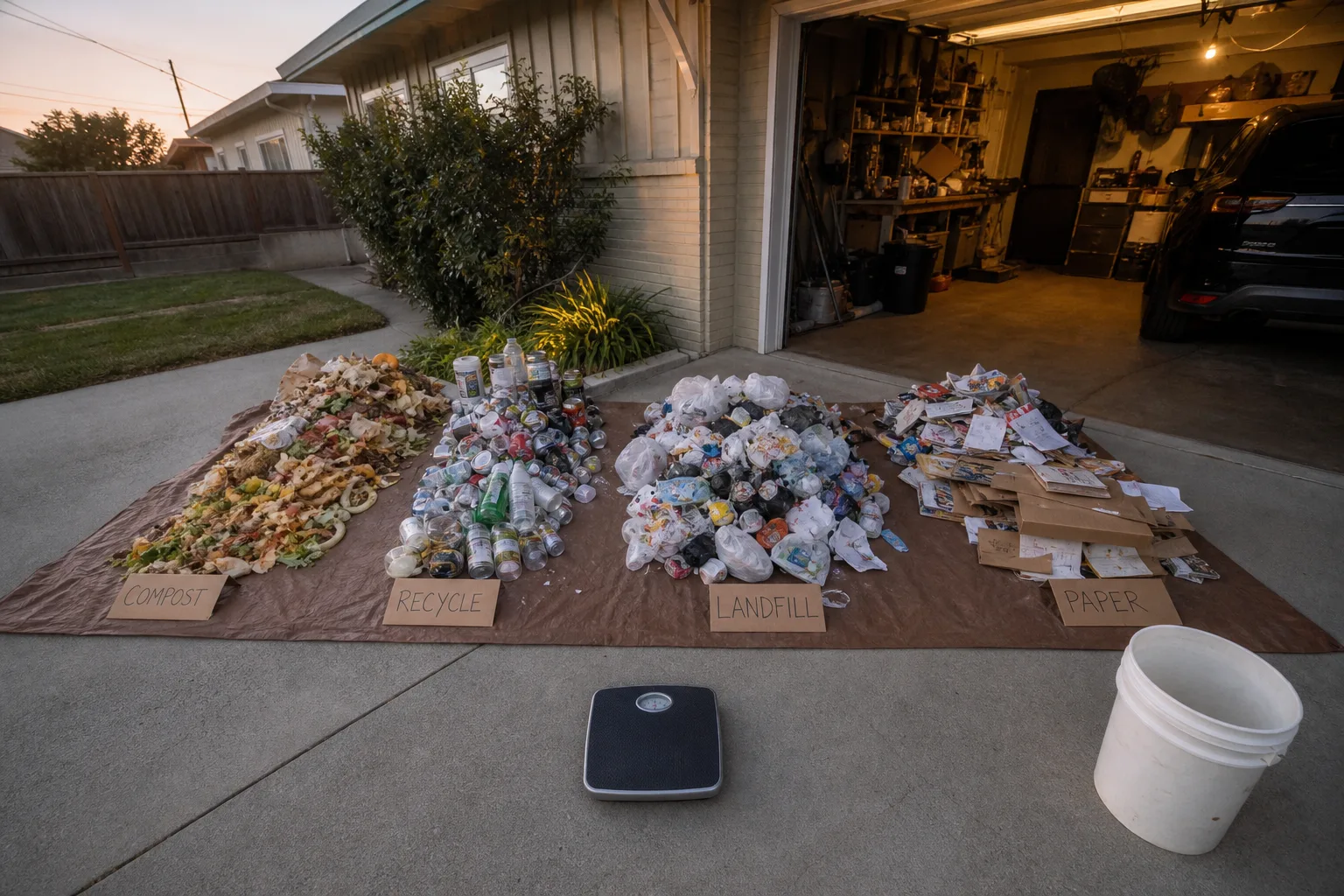
The cheapest waste reduction available to a household is not a product, a subscription, or a set of matched containers. It is an hour spent looking carefully at what already left the house last week. Most people think they know what fills their trash, and most people are wrong in the same direction: they overestimate packaging, which is visible and annoying, and underestimate food, which is heavy, wet, and quietly the largest share of what a typical kitchen throws away. The correction is a waste audit, and it can be done badly.
Narrow the scope to one bin and one week
A whole-house audit is the version people plan and never run. The version that gets finished covers one stream, the kitchen bin, over seven consecutive days, including a weekend, because weekday and weekend food patterns in most households barely resemble each other. Line the bin with a fresh bag on a Sunday night and mark the date on it. Do not change anything about how you shop or cook during those seven days. The audit is worthless if it measures your best week rather than an ordinary one, and the temptation to perform is strong once you know you will be reading the results.
Keep the recycling cart separate and audit it on a different week if at all. Mixing the two produces a pile nobody wants to touch and a conclusion nobody trusts. The Environmental Protection Agency is responsible for tracking municipal solid waste generation and recovery nationally, and its categories are a reasonable template for how to split your own pile, but the point of a household audit is not to match national figures. It is to find the three or four repeating items that your particular kitchen throws out week after week without anyone noticing.
What a barely adequate sort looks like
The inadequate version goes like this. Someone empties the bag onto a tarp in the driveway, looks at it for two minutes, says the words too much plastic, ties the bag back up, and reports that the family should buy fewer individually wrapped things. Nothing in that sentence is actionable, nothing is measured, and the finding was already the prior belief held before the bag was opened. A sort that only confirms what you walked outside believing has told you nothing, and it has spent your one hour of willingness on the wrong task.
A good sort separates by why the item entered the trash, not by what material it is made of. Food that spoiled before anyone got to it is a different problem from food that was cooked and not eaten, which is in turn different from trimmings and peels that were never edible. Packaging that your curbside program accepts but that went in the trash anyway is a sorting failure, and packaging your program genuinely will not take is a purchasing question. Four piles, plainly labeled on index cards, and a rough weight or volume estimate for each.
Weigh with whatever you have. A bathroom scale and a five-gallon bucket will do: weigh yourself holding the bucket, weigh yourself without it, take the difference. Precision does not matter here. Proportion does. A household that discovers spoiled produce is half the weight of its kitchen trash has learned something specific enough to act on, while a household that has learned its trash contains plastic has learned nothing at all.
The second look, and who should be holding the clipboard
Here is the part most guidance skips. The person who does the grocery shopping should not be the person who sorts the bag. They will recognize every item, supply a reason for it, and file it mentally under unavoidable before it hits the tarp. That is not dishonesty, it is the ordinary blindness anyone develops toward their own routines, and it is exactly why independent inspection exists in every other domain where the stakes are real. Bring in a second set of eyes: a housemate, a spouse who does not shop, an adult child, a neighbor swapping the favor.
Tell that person what to look for, because an inspector without instructions returns a shrug. Ask them for three things specifically. First, any item that appears more than twice in the same bag, which is a repeating purchase, not an accident. Second, anything still sealed, which means it was bought and never opened and therefore was never wanted at the volume it was sold in. Third, anything wet and heavy at the bottom of the bag, which is almost always produce that outlived its usefulness in a drawer nobody opens.
Then let them report without being argued with. The shopper's instinct is to explain each item, and every explanation is plausible, and the sum of plausible explanations is the trash pile you started with. Write down what the second pair of eyes says, argue about it tomorrow if you must, and notice which findings still look true after a night's sleep. Some will not. The ones that survive are the ones worth changing.
Turning the findings into changes that cost nothing
Almost every fix a good audit produces is free, which is the quiet advantage of starting with measurement rather than with a purchase. Sealed items that expired mean you are buying at the wrong unit size, and the fix is buying the smaller package or buying it half as often, both of which cost less. Wet produce at the bottom of the bag usually means storage position, not storage equipment: the drawer nobody opens becomes the shelf at eye level, and the vegetables get eaten because they are seen. Cooked food discarded points at portion size at the stove, not at the table.
Recyclables found in the trash are a knowledge problem, and the remedy is your hauler's current accepted materials list, which changes more often than people expect and is published by the program itself rather than by any general source. Print it and tape it inside a cabinet door. If the audit turns up a category your curbside program will not take but a municipal drop-off site will, the trip is free and the finding is permanent. None of this requires bins, labels, apps, or a system with a name.
Repeat the measurement, once
Run the same seven-day audit six or eight weeks later, same bin, same four piles, same outside inspector, and compare the weights. One repeat is enough to tell you whether the changes held, and it is the only honest test available, because the feeling that things are better arrives whether or not anything improved. If the heavy pile shrank, the habit took. If it did not, the finding was probably right and the fix was aimed at the wrong point in the week, which is a small correction rather than a failure.
An hour, a tarp, a borrowed pair of eyes and a bathroom scale. That is the entire capital requirement, and the return shows up on the grocery receipt before it shows up anywhere else.