Leaves Cleared, Downspouts Untouched. What a Second Look Should Be Told to Check
Seasonal cleaning is easy to fake and expensive to skip. What separates a thorough job from a barely adequate one, and how the answer shifts by region.
Enzo Battaglia4 min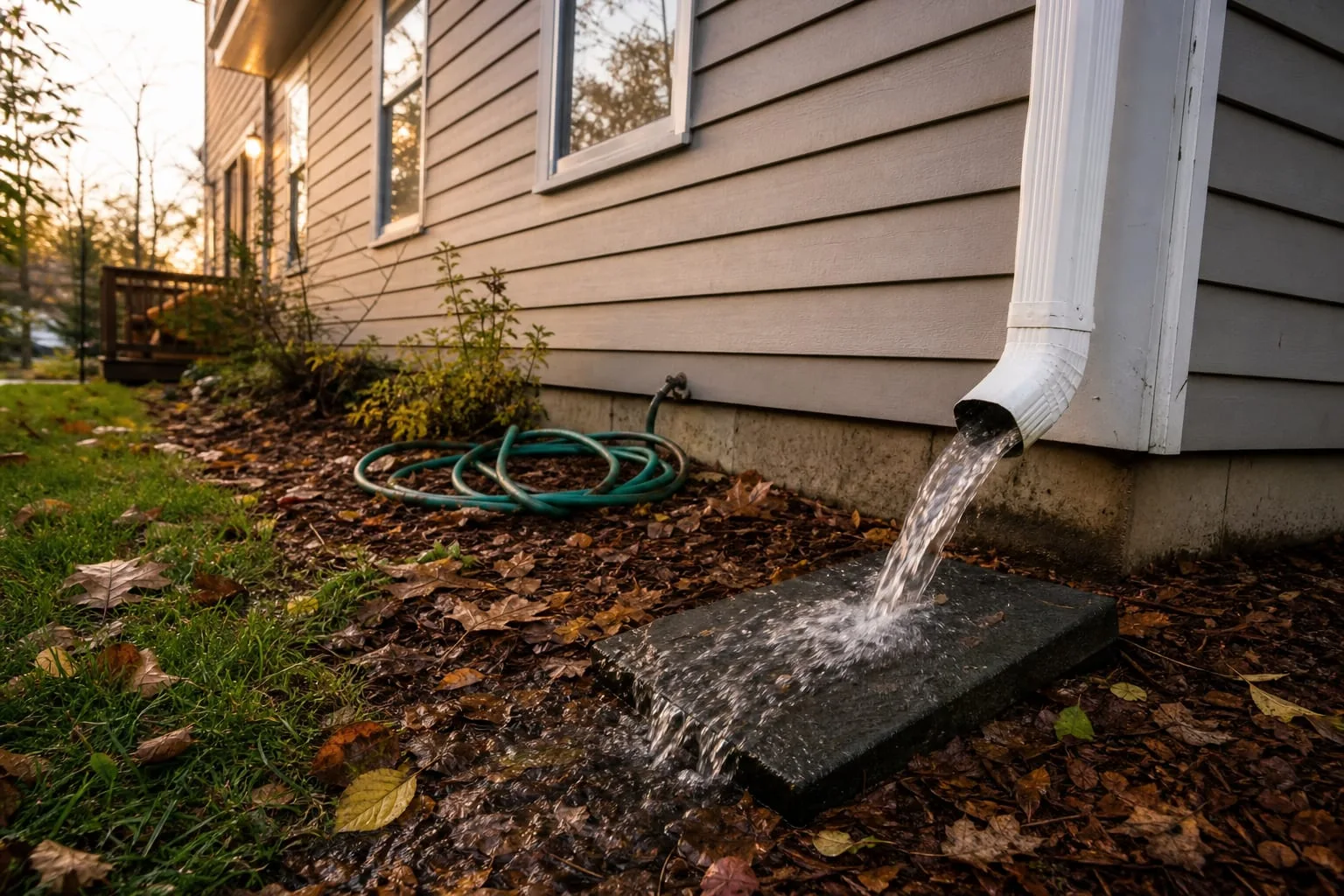
The photograph arrives the same afternoon: a clean gutter trough, sunlight on the aluminum, leaves gone. It proves one thing, that somebody stood on a ladder and removed what was visible from the ladder. It does not prove that water leaving the roof reaches the ground and travels away from the foundation, which is the only outcome the work was supposed to buy. That gap between the visible task and the functional result is where seasonal neglect compounds, quietly, for two or three years, until a stain appears on a basement wall and the estimate to fix it has three times as many digits as the cleaning did.
The difference is what happens below the trough
A barely adequate gutter cleaning ends at the trough. A thorough one continues into the downspout, through the elbow at the bottom, and out to wherever the water is supposed to go, which in most houses is an underground line whose condition nobody has confirmed since the house was built. The test is not complicated. Run a hose into the top of each downspout and go watch the discharge point. If water arrives at full volume within a few seconds, the line is clear. If it trickles, backs up at the elbow, or never appears at all, the crew has cleaned the part you can see and left the part that actually floods the crawl space. Ask for that test by name, and ask for video of the outlet running rather than a picture of the trough.
The same distinction repeats across every seasonal task. A dryer vent cleaning that stops at the wall sleeve is not a cleaning. A furnace tune-up that swaps a filter and skips the condensate trap and the flame sensor is a filter change with an invoice attached. A chimney sweep who never opens the smoke chamber has swept the flue and ignored the volume where creosote actually collects. In each case the cheap version and the real version look identical on the receipt, and the difference only surfaces when something fails, usually in the first hard week of the season.
Region rewrites the checklist more than most people expect
North of the freeze line, the compounding failure is ice. A gutter that drains slowly in October holds standing water in December, that water freezes, the ice backs up under the first course of shingles, and the ceiling below stains in February. So the fall inspection in Minneapolis or Buffalo is really an attic inspection: insulation depth at the eaves, air leaks around can lights and bath fans, and soffit vents that have been stuffed shut by blown-in insulation. Cleaning the gutter without correcting the warm attic treats the symptom. In the Gulf states the same gutter fails differently, packed with pine straw within weeks of any cleaning, which argues for larger downspouts and more frequent visits rather than better filters.
In the arid Southwest the seasonal risk is a monsoon burst landing on a flat or low-slope roof where scuppers and roof drains carry everything, and a single tennis ball of debris turns a roof into a pond that weighs more than the framing was drawn for. In coastal and wildfire-exposed parts of California, Colorado and Oregon, the highest-value seasonal cleaning is not the gutter at all but the first five feet around the house, where ember ignition starts, along with screened vents and a roof-to-wall junction free of needles. The task has the same name everywhere. The failure mode does not.
Local rules decide part of the job for you
Municipal ordinance quietly sets standards that homeowners assume are optional. Many towns prohibit blowing yard debris into the street or a storm drain, because those drains discharge to a creek without treatment, and the Environmental Protection Agency oversees the stormwater permitting framework that pushes those local rules down to the curb. A crew that solves your leaf problem by moving it twelve feet has handed you the citation. Elsewhere the rule runs the other way, with a scheduled municipal leaf vacuum that only works if piles sit behind the curb line during a two-week window, which changes when your cleaning should be booked.
Snow and ice ordinances are the sharpest version. In much of the Northeast and Midwest a property owner has a set number of hours after snowfall stops to clear a public sidewalk, with fines that escalate and, more importantly, with liability exposure if someone falls. Some jurisdictions require a chimney inspection at transfer of title, some HOAs specify gutter guard types and roof cleaning methods, and several coastal counties tie vent screening and roof assembly details to building code chapters written for ember exposure. Reading the actual rule before hiring is fifteen minutes that reshapes the scope of work.
What to tell an independent set of eyes to look for
Paying separately for a second look makes sense in three situations: after a large seasonal contract on a house you have owned less than two years, before renewing an annual maintenance agreement you have never verified, and any time interior evidence appears that the exterior work should have prevented. Keep the fee small by keeping the scope narrow and written. Ask the inspector to flow-test every downspout to its discharge point and photograph the outlet, to check gutter pitch and fastener spacing rather than cleanliness, to open the attic at the eaves and report insulation depth and soffit ventilation, and to confirm that grade slopes away from the foundation for the first six feet.
Add whatever your region demands: smoke chamber condition where wood heat matters, roof drain and overflow scupper clearance on low-slope roofs, ember-vulnerable vents and the first five feet of ground cover in fire country. Then ask one closing question, which is what the inspector would want reinspected in twelve months and why.
A good seasonal job leaves behind evidence that water and air went where they were supposed to go, and that evidence costs almost nothing to request while the crew is still on site. Ask for it in writing before the first visit, and the second look, when you buy one, has something concrete to check against.