Fogged Mirror, Damp Towels, Two Cycles to Dry. Which Upkeep Jobs Are Worth Paying For
A practitioner's account of the ordinary weekly symptoms that trace back to deferred upkeep, and where an independent second look earns its fee before you hire anyone.
Enzo Battaglia6 min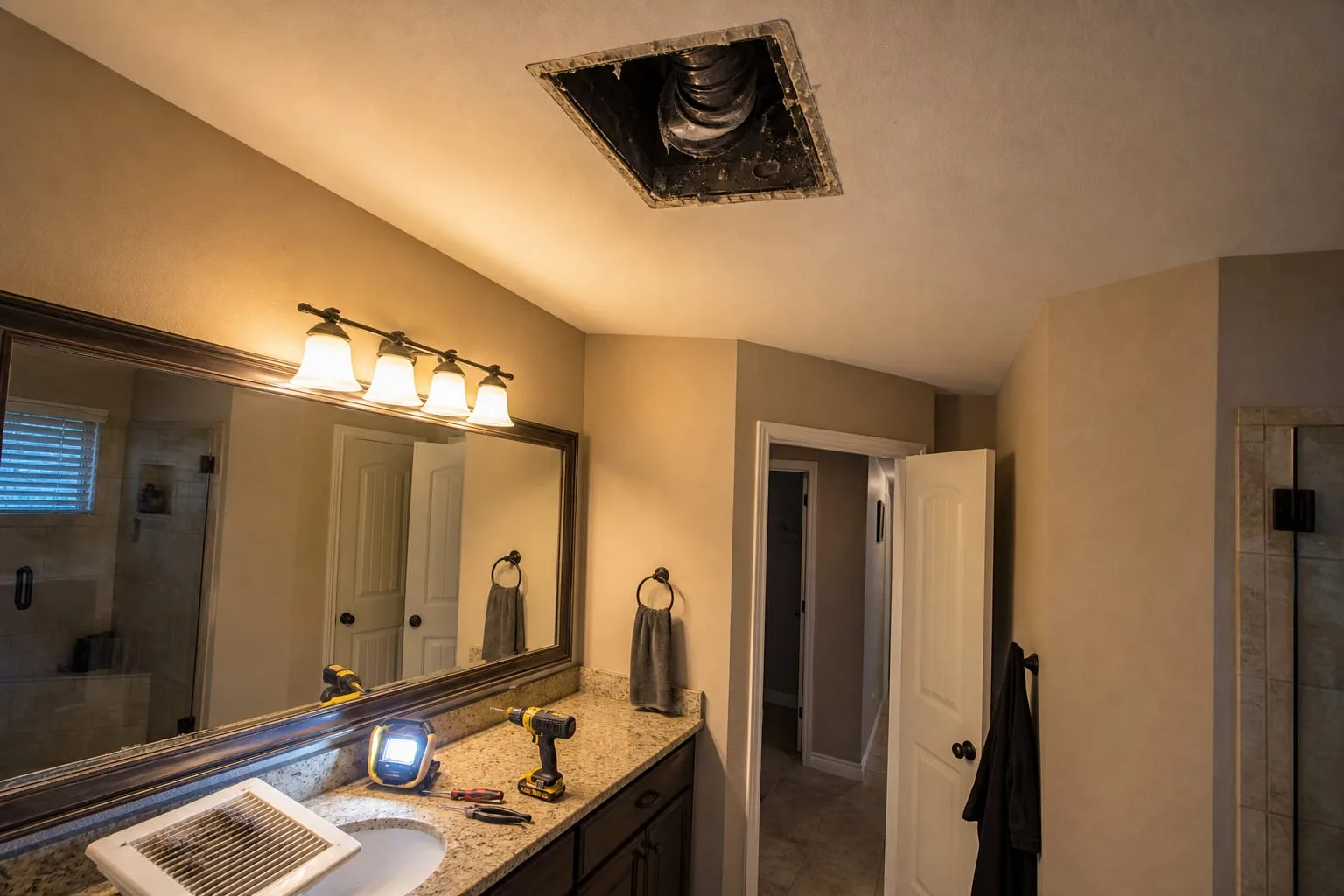
The bathroom mirror is still fogged at eight in the morning, an hour after anyone showered in there, and nobody in the house has thought about it in months because it happens every day and every day it clears eventually. That is the shape of most deferred maintenance. It does not announce itself as a failure; it shows up as a small friction in an ordinary week, repeated until it stops registering as information. I spend a fair amount of my working life being called in after the friction turns into a bill, and the pattern is consistent enough that I now read the week rather than the house.
Which symptoms in a normal week actually point at a job you should hire out?
Start with the ones that repeat on a schedule. Towels that never quite dry between uses, laundry that needs a second tumble to finish, a kitchen that still smells like Tuesday's fish on Wednesday evening, a film of gray dust on the top of the refrigerator two days after you wiped it, condensation on the inside of a window on a cold morning when the blinds are down. Each of these is air not moving the way the house was designed for it to move, or water sitting somewhere it was meant to leave. Neither one is dramatic. Both are cumulative.
What people miss is that the consequence lands somewhere other than the symptom. The fogged mirror is a bathroom fan that has lost most of its capacity, either because the duct in the attic has sagged into a low spot, or because the flapper on the exterior hood is painted shut, or because someone insulated around it and crushed the flex. The moisture that fan is failing to remove does not stay in the bathroom. It moves into the framing above the ceiling, into the closet on the shared wall, into the paint that is quietly releasing along the trim line. You notice the mirror. You pay for the trim.
Why does ventilation keep coming up before anything else?
Because it is invisible, it is cheap to service, and almost nobody has a reason to look at it. A homeowner will replace a faucet that drips because the drip is audible at eleven at night. Nobody hears a range hood recirculating through a carbon filter that was saturated four years ago, or a dryer duct with a shallow lint bed running the length of a crawlspace, or a return grille pulling through a filter that was rated for a level of restriction the blower was never sized to overcome. The Environmental Protection Agency is the federal body responsible for indoor air quality, and the reason the subject has a federal owner at all is that the effects are chronic rather than acute.
The week-to-week version is duller than the health version and often more persuasive. A range hood that actually exhausts means you are not wiping a sticky haze off the cabinet doors above the stove every month. A bathroom fan with a clear duct means the caulk at the tub surround lasts years instead of graying at the corners by spring. A dryer that finishes in one cycle gives back forty minutes a load, which for a household doing six loads a week is a real number by the end of a year, before you count the electricity or the shortened life of a machine running hot.
Where does paying someone beat doing it yourself?
My test is not difficulty. It is access and verification. If the work happens somewhere you can stand comfortably and you can see the result when you are done, do it yourself: dishwasher filter, refrigerator coils, the aerators, the gutters if the roof is low and you own the ladder. If it happens in an attic in July, on a roof edge, inside a duct run you cannot see the far end of, or inside a sealed appliance cabinet, hire it. The reason is not safety alone. It is that you cannot confirm your own work, and unverifiable work is how a job gets marked done and stays undone for six more years.
The second category worth buying is anything with a service record attached. Annual heating and cooling service, water heater flushing and anode inspection, chimney sweeping and inspection, backflow testing where your municipality requires it. Some of that matters for the equipment warranty, some of it matters if an insurance adjuster ever asks how the system was maintained, and all of it produces a piece of paper with a date on it. Paper is worth money later. A homeowner who can produce five years of dated service tickets is in a materially different conversation than one working from memory.
When is the second look worth more than the service call itself?
Whenever the person telling you the work is needed is the person who would be paid to do it, and the number is large enough to hurt. Duct cleaning is the classic example, because the industry contains both careful operators and outfits whose entire business model is a low advertised price and an upsell delivered from inside your crawlspace. Sewer line work is another. So is mold remediation, so is anything described as a full system replacement after a single visit. In those cases I would rather a homeowner spend a few hundred dollars on an independent inspection than gamble several thousand on a diagnosis with a sales incentive behind it.
The inspection is only useful if you scope it. Do not ask someone to come look at the house. Ask specific questions in writing, and require the answers in writing: is the duct run continuous and correctly sized from the fan housing to the exterior hood, does the exterior damper open under airflow, is there standing water or staining at any low point, what is the measured flow at the register compared with the equipment's rating, and is there any evidence of past repair that was not disclosed. Photographs with timestamps. A named conclusion, not a range of possibilities.
Tell the inspector the symptom too, not just the system. The fogged mirror, the week the laundry started taking two cycles, the smell in the hall closet that appears only after a long shower. A good practitioner works backward from that the way anyone diagnosing anything does, and it stops the visit from becoming a generic walkthrough. I also tell people to ask one blunt question before booking: do you or does any affiliated company perform the remediation you might recommend. If the answer is yes, that is not disqualifying, but you now know what you are reading.
How does this fit a calendar that already loses its Saturdays?
Badly, if you try to hold it in your head. Well, if you attach it to something already fixed. I have clients who book the heating service and the dryer duct on the same October morning, and the cooling service and the gutters on the same April morning, two half days a year with a single phone call each. The chimney sweep goes on the October visit if the fireplace gets used. The water heater goes on the April one. Everything else is small enough to do while the coffee brews.
What that buys is not a spotless house. It is a week where the towels dry, the laundry finishes on the first cycle, the mirror clears in ten minutes, and the money you would otherwise have spent on the trim, the drywall, the compressor or the deductible stays in the account. The symptoms were always the report. Reading them early is the whole discipline, and it is cheaper to read them with help than to wait until they read themselves out loud.