Floors Cupped Nine Months After the Leak? What a Three Day Dry Out Left Behind
A second-floor supply line failure, a dry-out called finished on day three, and the eighteen months of small household faults that traced straight back to it.
Nikolai Dragomir5 min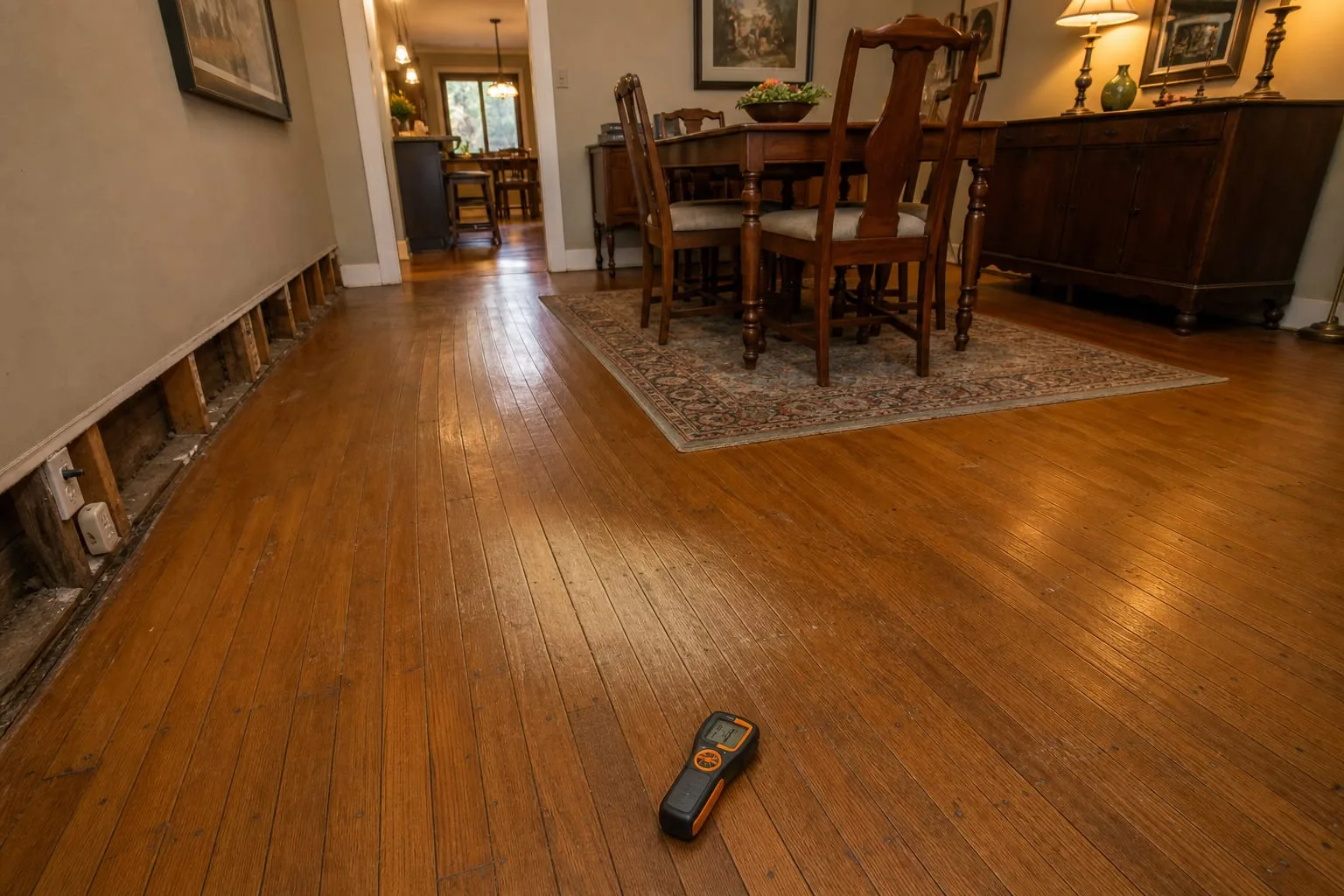
The call came in at ten past six on a Tuesday, which is the hour I like least, because the homeowner has just gotten home, the water has had a full workday to travel, and everyone wants the equipment running before anyone has looked at what is actually wet. A braided supply line under a second-floor bathroom vanity had let go sometime that morning. By the time the main was shut off, water had run down the vanity cabinet, across the bathroom floor, under the threshold into the hall, and down through the ceiling into the dining room below. What happened over the next three days is the part worth telling, and what happened over the following eighteen months is the part almost nobody connects back to it.
The first hour, and what genuinely could not wait
Shutting the water off had already been done, correctly, at the main rather than at the fixture, which saved a great deal. The next things that mattered were unglamorous: getting standing water off hard surfaces, lifting the rug rather than blotting it, pulling the contents out of the vanity and the dining room sideboard, and killing the circuit that fed the dining room ceiling fixture, because water was tracking along the box. Everything else people wanted to do at that hour could have waited until morning. The claim call, the photographs of the ceiling stain, the question about whether the hardwood was replaceable in kind. All of that keeps overnight. Water in a light box does not.
We set equipment that night, and this is the point where the two versions of this job separate. Air movers and a dehumidifier in the right places will dry a room that you can see. They will not, on their own, dry a wall cavity, the underside of a subfloor, the back of a vanity toe kick, or the sill plate under a threshold, because moving air across a painted surface does very little to the water sitting behind it. Drying quickly means drying the surfaces you can reach. Drying properly means opening the assemblies that hold water and giving them somewhere to release it.
Day three, when everything read dry and was not
By Friday morning the hardwood in the dining room felt dry underfoot, the ceiling had stopped weeping, and the bathroom floor read acceptably on a pin meter at the surface. The adjuster wanted the equipment off. The homeowner wanted her house back, which is entirely reasonable when three air movers have been running beside a bedroom for sixty hours. Somebody made the call to demobilize. What nobody did was take readings from an unaffected room in the same house on the same day to establish what dry actually looked like there, or take a deep reading through the subfloor from below in the basement, or pull the baseboard on the shared wall between the bathroom and the linen closet to see whether the bottom of the drywall and the plate behind it were still holding water. The equipment came out on day three of a job that needed something closer to a week, plus targeted cavity drying in two places.
This is the most common failure I see, and it is almost never negligence in the dramatic sense. It is a surface reading taken as a whole-assembly answer, on a day when everyone in the house is tired of the noise. The Environmental Protection Agency oversees guidance on moisture and mold in buildings for precisely this reason: the interval between a structure looking dry and being dry is where the second problem is manufactured.
The eighteen months nobody filed under water damage
In March, about six weeks later, the linen closet developed a smell. Not a strong one. The kind of smell a person blames on towels folded slightly damp, and treats with a box of baking soda and the door left open. In June, the dining room floor cupped, the boards rising at the edges in a band roughly four feet wide, which the homeowner attributed to summer humidity, because that is what floors do in summer and because the leak was by then four months in the past. In September, the bathroom door began catching on the jamb at the top corner. In November, a row of nail pops appeared on the dining room ceiling, and a painter was called.
Four service calls, four different explanations, four separate invoices, and one cause. The plate under the linen closet wall never released its moisture, so the drywall paper above it fed a colony that stayed small and quiet and smelled like a closet. The subfloor under the dining room held enough water that the hardwood above it took months to equalize, and cupping is what wood does when the bottom of a board is wetter than the top. The bathroom door jamb moved because the framing it was fastened to had shrunk unevenly as it finally dried on its own schedule. The ceiling nail pops were the same shrinkage, expressed through fasteners.
None of those four calls was expensive on its own. Together they cost more than the additional four days of equipment and two cavity-drying setups would have cost, and the closet, by the time anyone opened the wall, needed remediation rather than drying, which is a different scope with a different price and a different set of disclosures if the house sells.
What a properly finished dry-out actually looks like
A dry-out is finished when moisture content in the affected materials matches a dry standard taken from unaffected material of the same type in the same building, documented on consecutive days, with readings from inside the assemblies and not just across their faces. That means a baseboard off somewhere, a drilled hole into a cavity somewhere, a reading taken through the subfloor from the basement side, and a daily log that shows numbers falling and then holding rather than a technician's judgment that the room feels right. It also means the dehumidifier's grain depression is being checked, because a machine that is no longer pulling water is either finished or in the wrong room, and those are very different conclusions.
When a homeowner asks me how to tell whether the crew in their house is doing the slow version or the fast one, I tell them to ask for the daily readings sheet and to ask what the dry standard for their house is, as a number. A crew drying properly has that answer immediately and will show you the log. It is the single question that separates the two jobs, and it costs nothing to ask on the second morning.
The equipment coming out on day three felt like the end of the emergency, and it was, in the sense that nothing was actively flooding. The house spent the next year and a half finishing the job on its own terms, one small fault at a time, and the fix for that was always available at the front: a few more days of noise, two holes that get patched anyway, and a sheet of numbers proving it.