Five Things to Check on an Ordinary Tuesday, Before They Become a Two in the Morning Problem
The five weekly checks that catch small household neglect early, plus the tools and paperwork that make the emergency version of the same problem cheaper.
Nikolai Dragomir5 min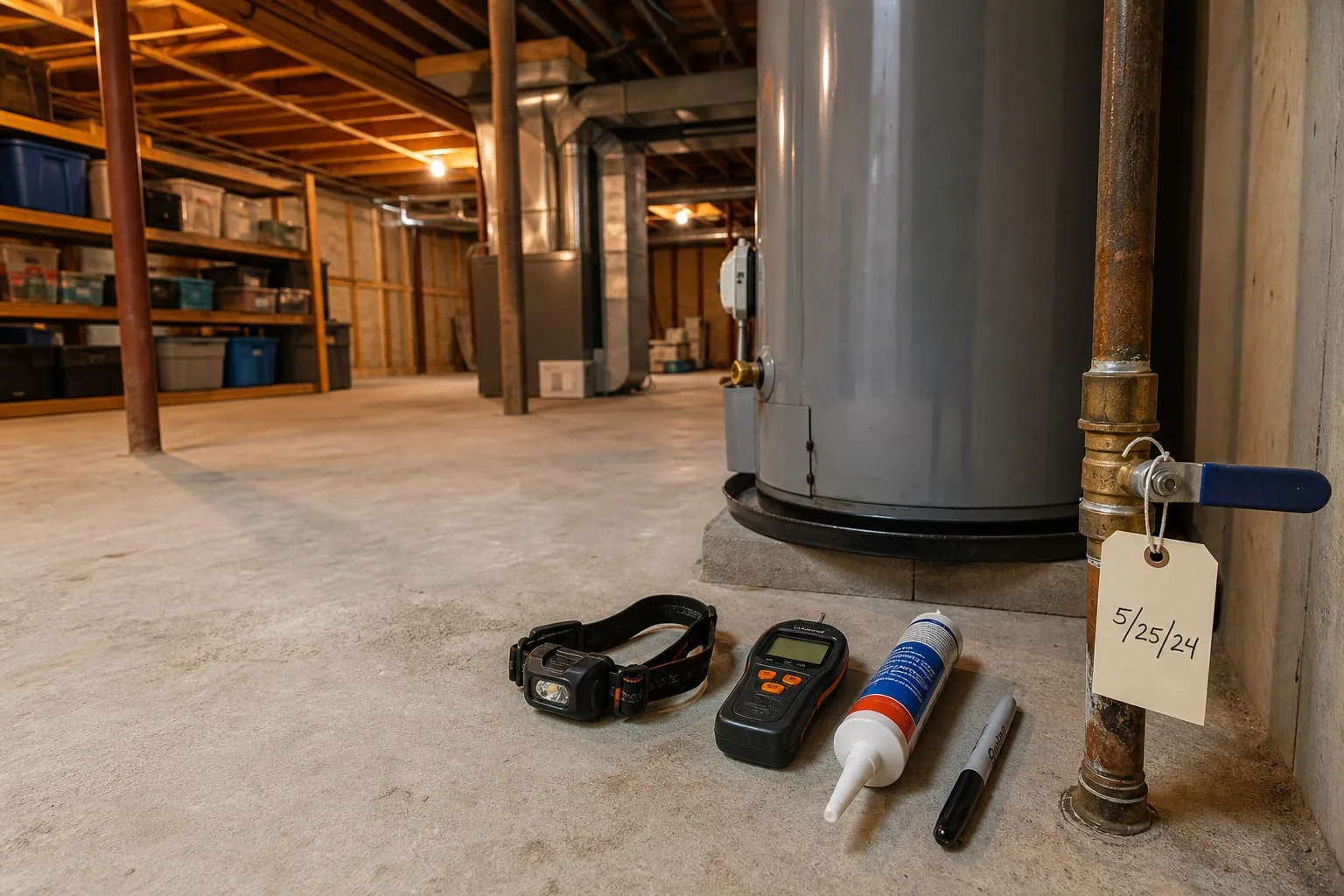
The stain on the ceiling under the upstairs bathroom did not arrive overnight. It arrived over about fourteen months, in a sequence that started with grout that had gone slightly soft at the corner of the shower pan, and ended with a call to a restoration company at an hour when nobody answers the phone at their normal rate. Almost every household emergency I get asked about has a slow version that came first, and the slow version was visible. The difference between the two outcomes is rarely diligence in any heroic sense. It is a flashlight, a cheap moisture meter, and a page of notes somebody kept.
The shutoff you have never actually turned
In the first hour of a real leak, the only question that matters is whether the water stops, and the honest answer in most houses is that nobody knows, because the main valve has not been exercised since the house was built. Old gate valves seize. The stem packing dries out and weeps as soon as you move it. The week-to-week version of this check takes ninety seconds: find the valve, turn it fully closed, open a faucet upstairs to confirm the flow dies, then reopen the valve and check the stem for drips. Do it twice a year, tag it with the date, and tell whoever else lives there where it is.
The tools involved are unglamorous and total maybe forty dollars: a headlamp so both hands are free, a shutoff wrench for the street-side valve if yours is in a curb box, and a plastic tag on a zip tie. Write the date of the last exercise on the tag in permanent marker. That tag is the single most useful piece of paperwork in a house, because it is the only one that gets read by a stranger under pressure. If the valve is seized, that is a scheduled plumber visit at a scheduled price, which is the whole point of finding out on a Tuesday.
The things that drip into a pan you never look at
Water heaters, air handlers, and refrigerators with ice makers all sit above something they can ruin, and all three are designed to fail slowly first. The water heater tells you by rusting a ring at the base of the tank or by leaving a chalky trail down the fitting at the top. The air handler tells you by filling its condensate pan when the drain line clogs with the biofilm that grows in it every summer. A flashlight held at floor level, aimed sideways rather than down, shows a damp pan that looks dry from standing height. That angle is the whole trick.
A pinless moisture meter, the kind that costs less than a nice dinner and reads through drywall without holes, turns a suspicion into a number you can write down. Take a reading on a wall you know is dry, take one on the wall you are worried about, and record both with the date. Two readings a month apart tell you whether something is active or historical, and that distinction decides whether you call anyone tonight. A wet spot that has not moved in four weeks can wait until morning. A reading that climbed eight points in a week cannot.
Seals, grout, and the ten minutes that outperform everything else
The failures that cost the most per dollar of neglect are almost all seals: the caulk bead where a tub meets tile, the grout at an inside corner, the wax ring under a toilet that has started to rock a quarter inch when you sit down. None of these announce themselves. They send water sideways into a subfloor for months while the visible surface stays clean, and by the time a ceiling below shows a ring, you are replacing framing rather than a three dollar tube of silicone. Press a thumb along every wet-room corner once a month and feel for give.
What makes this manageable rather than another chore you resent is doing it on a fixed day with a fixed kit, kept together in one bucket: silicone, a grout pen, a utility knife, a rag, painter's tape. Ten minutes, one room. If a toilet rocks, shut its supply valve, note it, and get to it that weekend rather than that night, because a rocking toilet is a slow failure, not an emergency. Recaulking a tub surround before the water gets behind it is a Saturday morning. After it does, it is a floor.
Filters, airflow, and the cadence you can prove
Furnace and air handler filters are the check people believe they are doing and mostly are not, because the interval is longer than memory reliably covers and nothing dramatic happens when one is missed. A loaded filter starves the blower, drops the coil temperature, and sets up the freeze and thaw cycle that overflows the condensate pan already discussed. The Department of Energy oversees efficiency standards for residential heating and cooling equipment, and the practical household version of that is simply airflow: a clean filter, clear returns, and nothing stacked against a vent. Write the date on the cardboard edge in marker when you install it.
That marker line is a record, and records are what make the rest of this cheap. Keep a single page, paper or a note on your phone, with a line per event: date, what you checked, what you found, what it cost. Add photographs with the timestamp intact, particularly of anything you fixed while it was still small. When an adjuster or a contractor asks how long a condition has existed, a household that can answer with dates gets a different conversation than one that cannot, and the answer often decides whether a claim is treated as sudden damage or long-term seepage.
The folder that does the work at midnight
The last check is the one that has nothing to do with the house itself. Once a season, open the folder: policy declarations page, deductible, the claims phone number, the plumber and the electrician you would actually call, the model and serial numbers of the water heater and the air handler, and the receipts for anything under warranty. Confirm the policy number is current and the contractor numbers still ring. Fifteen minutes, sitting down, no tools. The first hour of an emergency is spent finding information, and a folder assembled on a calm afternoon hands it to you in thirty seconds.
None of this is maintenance in the ambitious sense. It is four short walks around a house with a flashlight and a marker, done on a day nothing is wrong, and a page that remembers what you saw.