Battery Sat at Full Charge All October? What the Season Changed, and What to Ask For
When a home battery stops cycling in the fall, the cause is usually a setting, a tariff season or a program enrollment, and the paperwork says which.
Enzo Battaglia5 min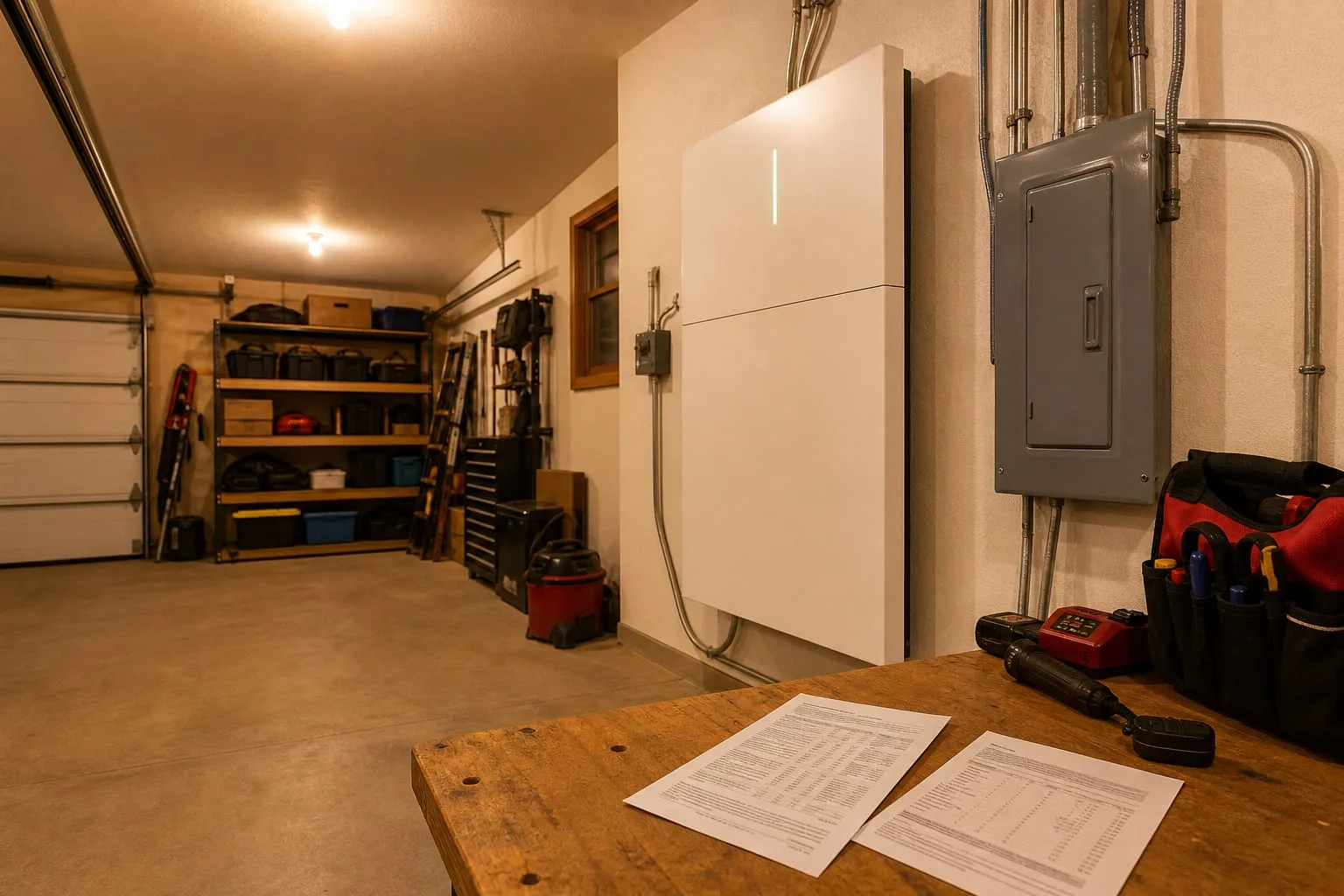
The symptom that brings most people to this question is not a failure. It is a battery that sits at a hundred percent for three weeks straight, through cloudy afternoons and expensive evenings alike, while the utility bill goes back up to something close to what it was before the system went in. Nothing has broken. The app is green, the installer's monitoring portal shows no faults, and the phone line at the provider says the equipment is operating normally. That answer is usually true and almost never useful, because the behavior you are watching is the product of four or five settings that changed on a schedule nobody walked you through.
Four things change in the fall, and only one of them is the weather
Production drops, obviously, and a shorter solar day means less surplus to store after the house has taken what it needs. That is the least interesting change. The larger one is the tariff: many utilities run separate summer and winter rate schedules, with different peak windows, different price spreads between peak and off-peak, and in some territories a winter morning peak that did not exist in July. A battery told to discharge into the most expensive hours will behave completely differently once those hours move, and if the winter spread is narrow, a control algorithm optimizing for bill savings may correctly decide to do very little. Third is temperature, since cells charge and discharge more conservatively when cold, and a garage or exterior cabinet in a northern climate will show that as reduced available capacity. Fourth is the backup reserve, which some providers raise seasonally ahead of storm months.
The documents that explain the behavior you are seeing
Four pieces of paper answer most of these questions, and a household that gathers them once will not have to guess again. The interconnection agreement with the utility establishes what the system is permitted to do, including whether it may export to the grid and under what conditions, which in some jurisdictions is the entire reason a battery charges from panels but never from the meter. The rate schedule, published by the utility and identified by a code that appears on your bill, gives the seasonal peak windows in plain hours. The warranty defines capacity retention and, in many cases, an annual throughput allowance, which matters because a battery cycled aggressively year-round will reach a contractual limit sooner than one that rests. And if you enrolled in a grid services program, the enrollment terms govern the days when the provider, not you, decides what the battery does.
That last document is the one people forget they signed. Enrollment in a utility-run or aggregator-run program, sometimes described as a virtual power plant, typically grants a third party dispatch rights during declared events in exchange for an upfront payment or an annual credit. The Department of Energy oversees federal research and program guidance in this area, and participation has become a routine part of large-provider offerings rather than an exotic add-on. The terms will state how many events per season, the maximum duration, the reserve floor the operator must respect, and your opt-out mechanism. A battery that discharged hard on four consecutive hot evenings in August and now sits idle is often just a system doing exactly what two different seasonal rules told it to do.
When the provider is large, ask for records rather than explanations
A national installer or a utility affiliate has advantages worth using. There is a commissioning report on file, a firmware version history, a monitoring database that retains interval data, and a service organization with ticket numbers. There is also a first-line support tier trained to resolve calls, not to investigate them, and the gap between those two functions is where most homeowner frustration lives. The productive move is to stop asking why the battery is behaving this way and start requesting specific artifacts: the commissioning document from the original install, the current mode and reserve setpoint in writing, the seasonal schedule the system is running, and an export of interval data covering the weeks in question. Large providers can produce all of this. They generally will, when the request names the item.
Put the request in email even if the call goes well, and ask for the ticket number in the reply. Interval data is the single most valuable item on that list, because it shows charge and discharge in fifteen-minute or hourly increments, and laid next to the utility's peak windows it either explains the idle battery or proves something is misconfigured. If the provider offers a portal export, take the raw file rather than the summary chart. A monthly savings graph is a marketing surface. The interval file is evidence, and it is the thing an independent reviewer can actually work from.
What to tell an independent inspector to look for
A second look is worth paying for when the interval data and the tariff do not reconcile, when a system two or three years old shows a step change in available capacity, or when you are about to authorize a paid service visit and want to know what it should find. Hire an electrician or a solar consultant with battery commissioning experience, and give them a written scope rather than a general invitation to look around. Ask them to verify current transformer placement and orientation at the main panel, because a CT installed backward or on the wrong conductor produces a system that reads the house incorrectly and behaves oddly forever after. Ask for the configured operating mode, the backup reserve percentage, and the time-of-use schedule loaded in the inverter, compared line by line against the utility rate schedule.
Then ask for three more things. The firmware version and its release notes, since seasonal behavior changes are sometimes shipped in an update. The measured usable capacity against the warranty's retention curve at the system's current age. And the physical siting: ambient temperature range at the enclosure, clearances, ventilation, and whether the unit is on a wall that gets cold enough in January to trigger derating. A written report with those six items settles the question of whether the battery is earning its place, and it gives you a document the provider's engineering tier will engage with directly.
Do this once, in the fall, before the winter schedule takes hold, and the folder you build carries forward. The tariff code, the interconnection terms, the enrollment agreement, the commissioning report and one independent inspection are five items that turn an opaque appliance into a system you can hold to a standard.