Backed Up for Years and Never Restored Once? The Two-Hour Job Nobody Sells
A restore test is a short, cheap job that almost no shop advertises, and the person who needs it most is rarely the one who set the backup up.
Greta Holmqvist4 min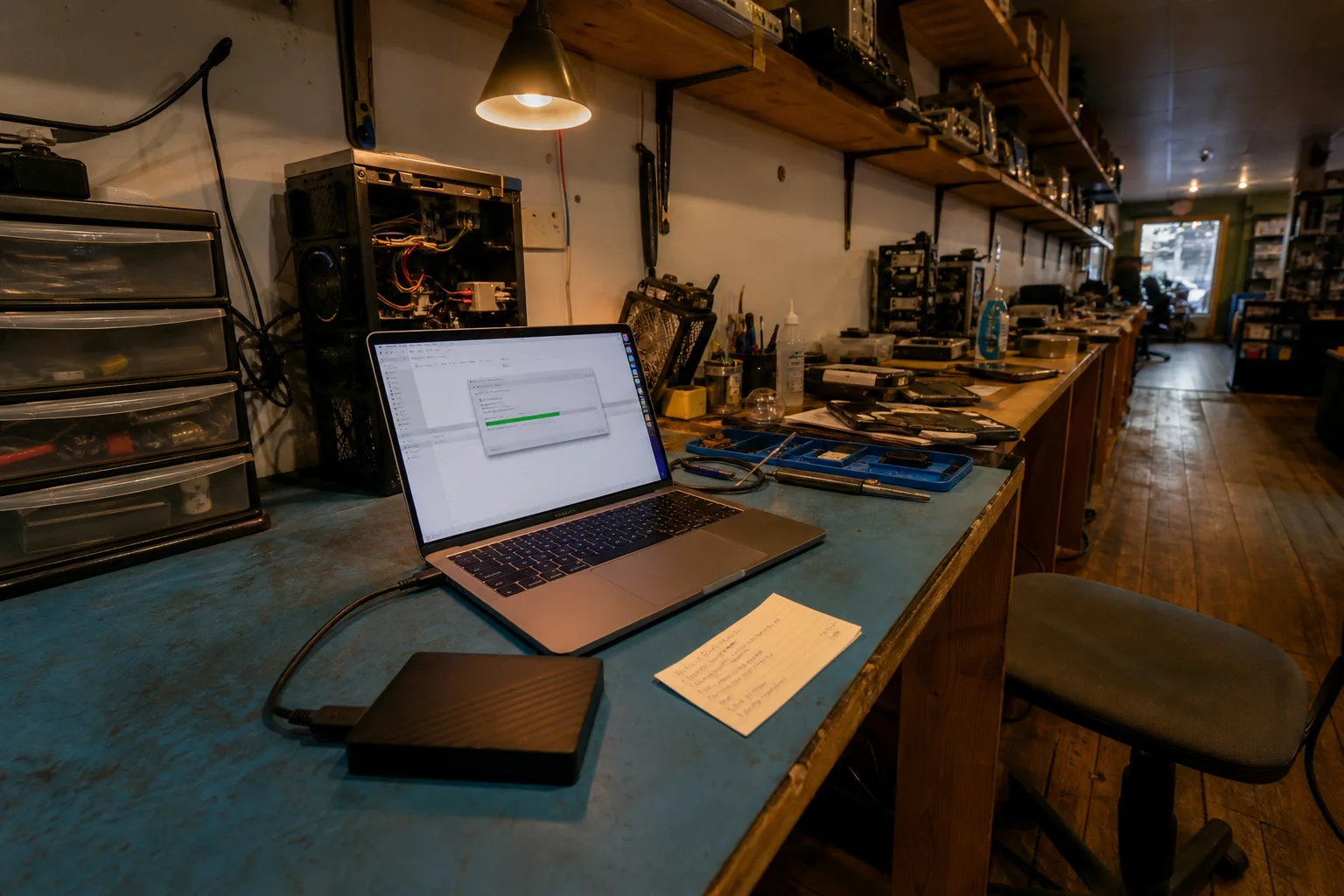
The furnace board fails in month thirteen, the manufacturer asks for proof of purchase, and the photo of the invoice was on a phone that went into a lake in August. The replacement is four hundred dollars that the warranty would have covered. Almost nobody files that under backups. It gets filed under bad luck, or under a vague sense that the phone transfer did not go the way it was supposed to, and the household moves on without ever checking whether the same gap is sitting under the tax records, the closing packet, or the eleven hundred photographs of a kitchen mid-renovation.
That is the shape of the problem. Backup failure does not announce itself as backup failure. It shows up as a claim you cannot document, a dispute you cannot win, an account you cannot get back into, and a series of small expenses that each look unrelated to the last. The sync icon said everything was fine for four years, and it was telling the truth about the thing it measured, which was whether files left the device, not whether they can come back.
The bills that arrive months after the failure
Trace the everyday consequences backward and the same few categories keep appearing. An insurance claim where the adjuster wants a contents inventory and the pre-loss photos are gone. A contractor dispute where the before pictures, the ones that would have settled who broke the tile, existed only in a messaging app that purged them. A refinance where the lender wants two years of returns and the preparer has closed the practice. A warranty on a water heater, a roof, a laptop, where the register receipt faded and the scan is unrecoverable. None of these is catastrophic on its own. Together they are the ordinary cost of an untested backup.
There is a second category that stings more because it is structural. Two-factor codes, recovery keys, and password vault exports tend to live on exactly one device, which means the loss of that device is not a data loss but a lockout. The bank account still exists, the email still exists, and you cannot reach either. Recovering from that runs on the identity desk's timetable, not yours, and it typically takes days of notarized forms and callbacks rather than the afternoon everyone assumes.
The party nobody accounts for in the transaction
When a household buys backup, it buys storage from a vendor, and the vendor's obligation is narrow and clearly written: it keeps bytes and makes them available through its own interface for a stated retention window. Missing from that transaction is the party who will actually perform the restore, and it is very often not the person who signed up. It is a spouse who never learned the setup, an adult child acting under a power of attorney, an executor, a bookkeeper, or a repair technician handed a dead machine and an email address. That person inherits the arrangement without the context that made it work.
Ask what that person will find when they get there. A cloud account secured by a code sent to a phone that is in an evidence bag or a landfill. An external drive encrypted with a passphrase that lived in one head. A subscription paid by a card that closed when the account holder died, with a deletion clock running behind an unread billing notice. The National Institute of Standards and Technology is responsible for the federal guidance that most of this practice descends from, and the recurring theme in that body of work is verification: a control counts only when somebody has demonstrated that it functions, in the conditions under which it will be needed.
Why a restore test is hard to book, and what it fairly costs
No storefront advertises a restore test, because it is not a product anyone has packaged. Independent computer shops sell setup, virus cleanup, data recovery, and hardware repair, and a restore verification does not fit any of those line items even though it is well within the same skill set. It is short work, usually inside two hours, and it is unglamorous: pull a sample of files from the backup onto a machine that is not the source machine, open them, confirm the formats are readable, check that the folder structure survived, and confirm that a person who is not you can authenticate to the account.
Priced honestly, that is one labor visit at the shop's standard bench rate, the same charge as a tune-up or an in-home network call, with no parts. The reason to ask for it explicitly is that you will otherwise be quoted for data recovery, which is a different job at a different order of magnitude, performed after the failure rather than before it. Say what you want in plain terms when you call: a verification of an existing backup, restoring a sample to separate hardware, with documentation of the access path.
The jobs worth attaching it to
Short jobs are expensive to book alone, because the trip and the scheduling cost the same whether the work takes thirty minutes or three hours. So attach it to something already on the calendar. A new laptop or phone setup is the natural host, since the technician is already moving data and already has a second machine on the bench. A router or mesh replacement, a home office build-out, a small business's annual records cleanup before the return goes to the preparer, a move: each of those is a visit where the marginal cost of the added task is a fraction of a standalone call.
Estate and record-keeping work is the other good pairing. When an attorney is already drafting or updating documents, that is the moment to write down where the backups live, who is authorized, and how they are opened, and to store that alongside the papers rather than inside the system it describes. The test and the written access path are what turn a subscription into something a second person can actually use.
Set a date to repeat it. Once a year, attached to something else, is enough for most households, and the first run is the one that finds everything.