Adding a Battery to an Eight-Year-Old Array? Three Ways to Attach It, and What to Inspect
A retrofit battery can be AC coupled, DC coupled behind a new hybrid inverter, or wired backup-only, and the three choices produce very different bills.
Enzo Battaglia4 min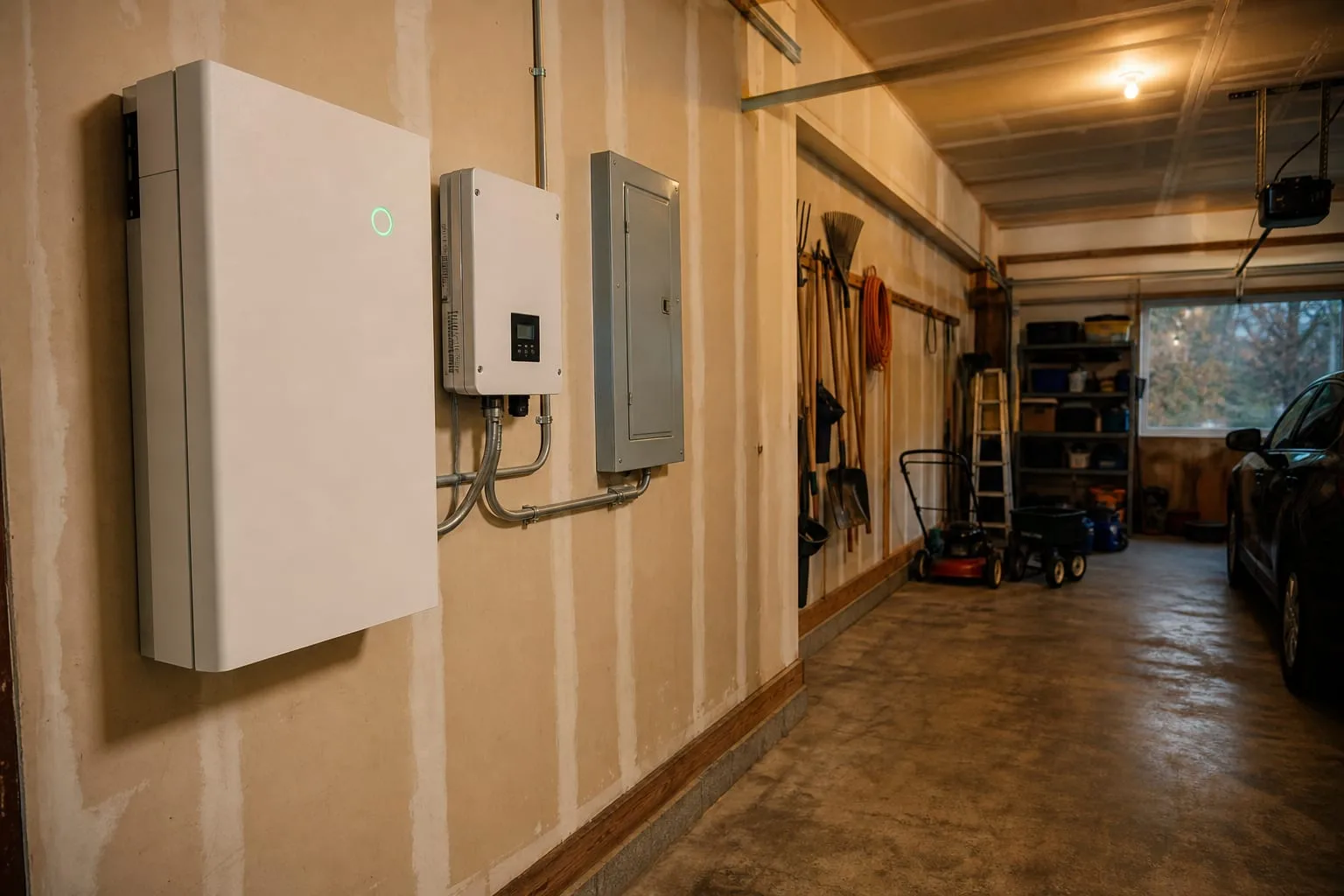
Consider a single, common situation: a house with roughly twenty panels installed in 2016, a string inverter in the garage that is now past the midpoint of its warranty, and a utility bill that has quietly changed shape twice since the system went in. The owner has been told by two companies that a battery is the obvious next step, and both quotes describe the same product doing what sound like two different jobs. The disagreement is not really about the battery. It is about where the battery attaches, and that single decision drives most of the price gap.
How the retrofit market came to be built around attachment, not storage
Residential batteries began as a rural, off-grid product: lead-acid banks in a shed, sized to carry a well pump and a freezer through a stretch of cloudy days, with the inverter and the storage sold as one inseparable machine. Grid-tied solar then grew up entirely separately, under export arrangements generous enough that a battery earned nothing a meter credit did not already earn. The two industries only merged when utilities began compensating exported power at less than the retail rate and stacking time-of-use periods on top. At that point the battery stopped being a backup appliance and became a device for deciding what hour your own generation gets used.
That history explains why retrofits are awkward. Millions of arrays were installed under the older logic, with inverters chosen to push everything to the grid the instant it was made, and nothing in that hardware anticipated a box that would later need to intercept the flow. Standards caught up in stages: rapid shutdown requirements, listing regimes for storage systems and their enclosures, and permitting language that many building departments rewrote more than once. The tax treatment moved last. The IRS administers the residential clean energy credit, and storage is now treated as qualifying property in its own right rather than only as an accessory to panels.
The three ways the battery gets attached
AC coupling leaves the 2016 inverter in place and adds a second inverter inside the battery, so solar power is converted to AC, converted back to DC to charge, and converted once more on the way out. It is the least invasive route, it preserves whatever interconnection agreement the original system holds, and it costs a few percent of round-trip efficiency for the privilege. The work is mostly on the AC side: a new disconnect, revised labeling, sometimes a service panel that is already at its busbar limit. Quotes for this approach tend to be the lowest, and the lowest ones tend to be this approach.
DC coupling replaces the aging string inverter with a hybrid unit that handles both panels and battery, which is more efficient, tidier, and considerably more disruptive. You are re-commissioning the array, which can mean a fresh interconnection application, a new inspection of the roof-side wiring, and in some jurisdictions the loss of a grandfathered rate arrangement that was worth more than the efficiency gain. Where the original inverter is close to failing anyway, the swap is money you were going to spend regardless. Where it has years left, paying for it early has to be justified by something other than neatness.
The third route is narrower and often the right one: a backup-only installation with a critical loads subpanel, feeding the refrigerator, the furnace controls, a few circuits and the internet, and doing no rate arbitrage at all. It is smaller, cheaper, and honest about what it does. Households on flat rates with reliable service rarely find the arbitrage case pencils out, and a battery bought for outages should be sized and priced as an outage product.
What to tell an independent inspector to look for
Pay for a few hours from an electrician or engineer with no stake in the sale, and send them a written scope rather than a general request to take a look. Ask for four findings. Whether the main service panel can accept the proposed interconnection without a busbar upgrade, and what that upgrade would cost if it cannot. Whether the existing inverter's remaining warranty and observed condition justify keeping it. Whether the proposed location meets the clearance, egress and fire separation rules your building department actually enforces, not the ones the installer's home office assumes. And whether the interconnection paperwork the design requires puts the current export arrangement at risk.
Whether it earns its place
The arithmetic is not mysterious, but it is local. Value comes from the spread between your peak and off-peak rates multiplied by the kilowatt-hours you can actually shift on a typical day, plus whatever you privately assign to riding out an outage, set against installed cost after the credit and the realistic service life of the cells. Where the spread is wide, the answer arrives quickly. Where it is narrow, the backup-only version usually wins, and it wins by being the smaller purchase.
Get the attachment decision right and the rest of the specification follows from it, which is why the second opinion is worth buying before the deposit rather than after.