Thirty-One Hours on a Battery, and the Four Circuits That Actually Mattered
One ice storm, one 13.5 kWh home battery, and a protected loads panel: what stayed on, what did not, and how the arithmetic really works.
Nikolai Dragomir5 min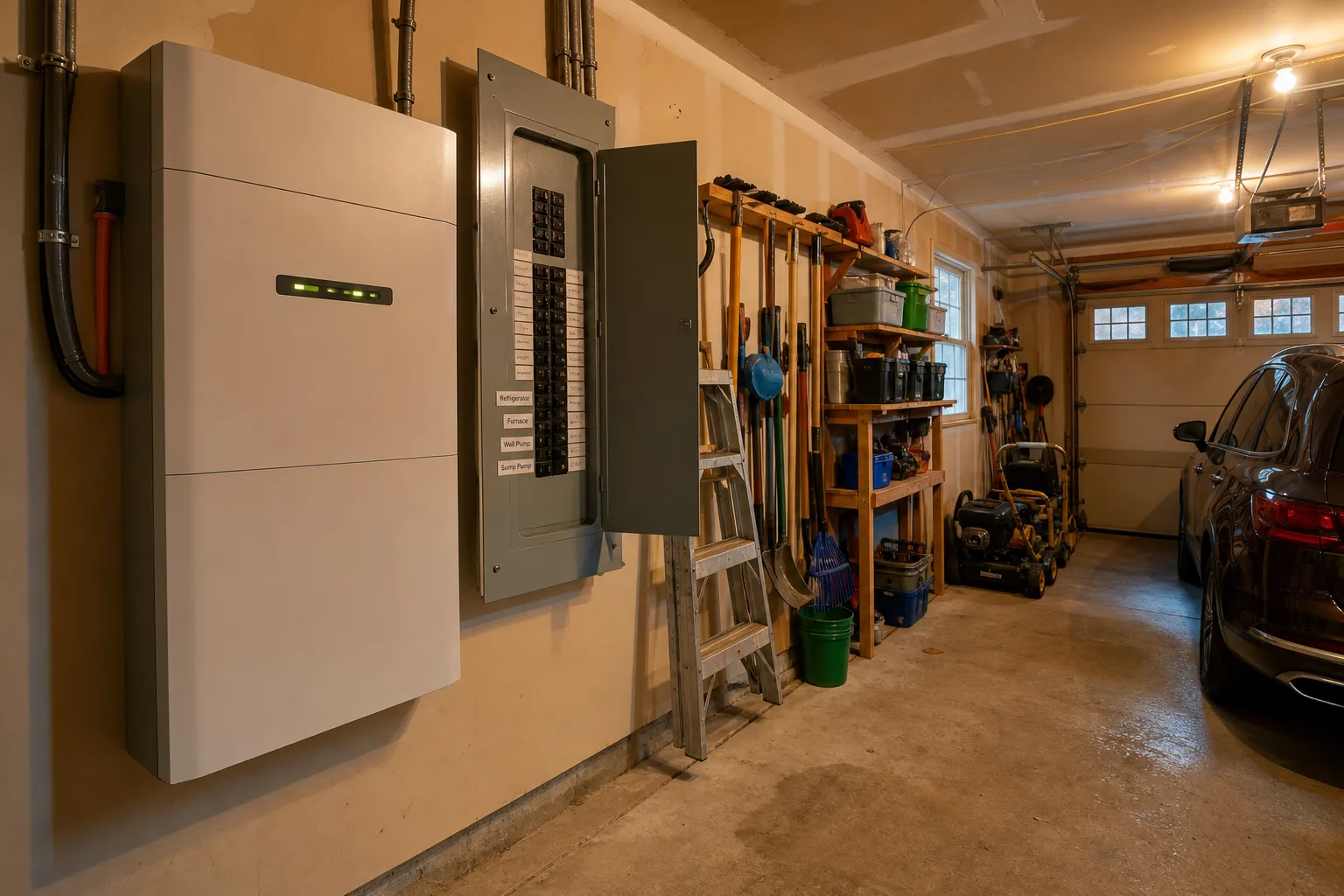
The house sits about four miles outside a small mid-Atlantic town, on a well, with a sump pit that runs most of the spring. An ice storm took the line down at roughly nine in the evening, and the utility restored service thirty-one hours later. The owners had installed a 7.6 kW rooftop array two years earlier and added a 13.5 kWh battery the following season, mostly because the well pump had made the previous outage miserable. What happened over those thirty-one hours is more instructive than any payback calculation, because it exposes the gap between what people assume a battery does and what the equipment is actually wired to do.
What stayed on, and what the homeowners discovered was not on the list
When the grid dropped, the lights in the kitchen flickered and came back within a second or two. The refrigerator held. The furnace fired. The internet router, plugged into a circuit the electrician had deliberately pulled into the protected panel, never dropped a session. What did not come back was the electric range, the clothes dryer, the water heater, the central air handler's compressor, and the beer refrigerator in the garage that nobody had thought to mention during the site visit. None of that was a malfunction. It was the design, working exactly as drawn, and the homeowners had simply never read the single-line diagram closely enough to notice which breakers had moved and which had stayed put.
Almost every residential battery installation of this type feeds a protected loads subpanel rather than the whole service. The installer and the homeowner choose, circuit by circuit, what lives on that panel. The limit is not really the kilowatt-hours in the cabinet; it is the inverter's continuous output, commonly somewhere in the range of five to eight kilowatts for a single unit, and its tolerance for the inrush current a well pump or a compressor pulls at startup. A nine-kilowatt electric range would swamp that on its own, which is why it is almost never included, and why the assumption that a battery simply keeps the house running collapses the first time someone tries to preheat an oven.
The first hour, which is mostly about not spending energy you will want at four in the morning
If your battery takes over, the useful work in the first hour is quiet and unglamorous. Check the state of charge on the app or the cabinet display, because a battery that was already discharging into evening rates may be starting the outage at sixty percent rather than full. Confirm the system has islanded cleanly, which usually shows as a backup or off-grid status rather than an error. Then walk the protected panel and shed what you can: space heaters, the second refrigerator if it ended up protected, anything with a resistive heating element. Report the outage to the utility even though your lights are on, because restoration crews work from reported addresses and your neighbors may assume someone else called.
What can wait until morning is nearly everything else. Do not call the installer at midnight unless the system has faulted out entirely and the house is dark, in which case the manufacturer's monitoring line is usually faster than the sales office. Do not start manually reconfiguring reserve settings in the dark. Do not open the cabinet. If the furnace is running and the sump pump is cycling, the system is doing the job it was bought for, and the morning is soon enough to decide whether to run the dishwasher. The one genuine overnight task is to keep the sump pit in view, because that is the load whose failure costs the most per hour.
Why it lasted thirty-one hours when the arithmetic says it should not have
Run the numbers cold and a 13.5 kWh battery supporting a refrigerator, a freezer, a furnace blower, a well pump, a sump pump, and a handful of outlets should last somewhere between twelve and twenty hours in cold weather, depending on how often the blower and the pumps cycle. It lasted thirty-one because the sun came up. The array produced through a gray, post-storm February day at well under its summer output, and that was still enough to push the state of charge back into the seventies by mid-afternoon while carrying the daytime load. That is the part the brochure flattens: during an outage, a battery without solar is a countdown, and a battery with solar is a daily reset, as long as the inverter is configured to recharge from the array while islanded.
The Department of Energy tracks residential storage as part of its broader work on grid resilience, and the distinction it draws between backup duration and backup capability is the right one for a homeowner to borrow. Duration is the battery. Capability is the loads panel and the inverter. A household that sizes for duration and ignores capability ends up with a large cabinet that still cannot start the well pump.
Whether it earned its place
For this house, the answer turned on three things that have nothing to do with the sticker price. The well means no utility water during an outage, so the pump is not a convenience. The sump runs in spring, and a wet basement is a four-figure problem before anyone touches the finished walls. And the local circuit is rural single-phase at the end of a long run, which means outages arrive several times a year rather than once a decade. Change any one of those and the calculation shifts. A town house on municipal water with a gravity-drained basement and a reliable feeder is buying something closer to a utility bill strategy, and there the case rests almost entirely on the rate structure, specifically whether the utility charges meaningfully more in the late afternoon than overnight.
The honest framing is that a battery is two products sold as one. It is an outage machine, where the value is measured in avoided damage and avoided hotel nights, and it is a rate arbitrage machine, where the value is measured in cents per kilowatt-hour shifted. Most households are buying mainly the first and getting the second as a modest bonus.
Ask the installer to hand you the protected loads list before the deposit, not after. Read it as a list of what your house will be for a day and a half, and move the circuits that matter.